Grocery Budget in Pakistan: How Much Should a Family Spend?
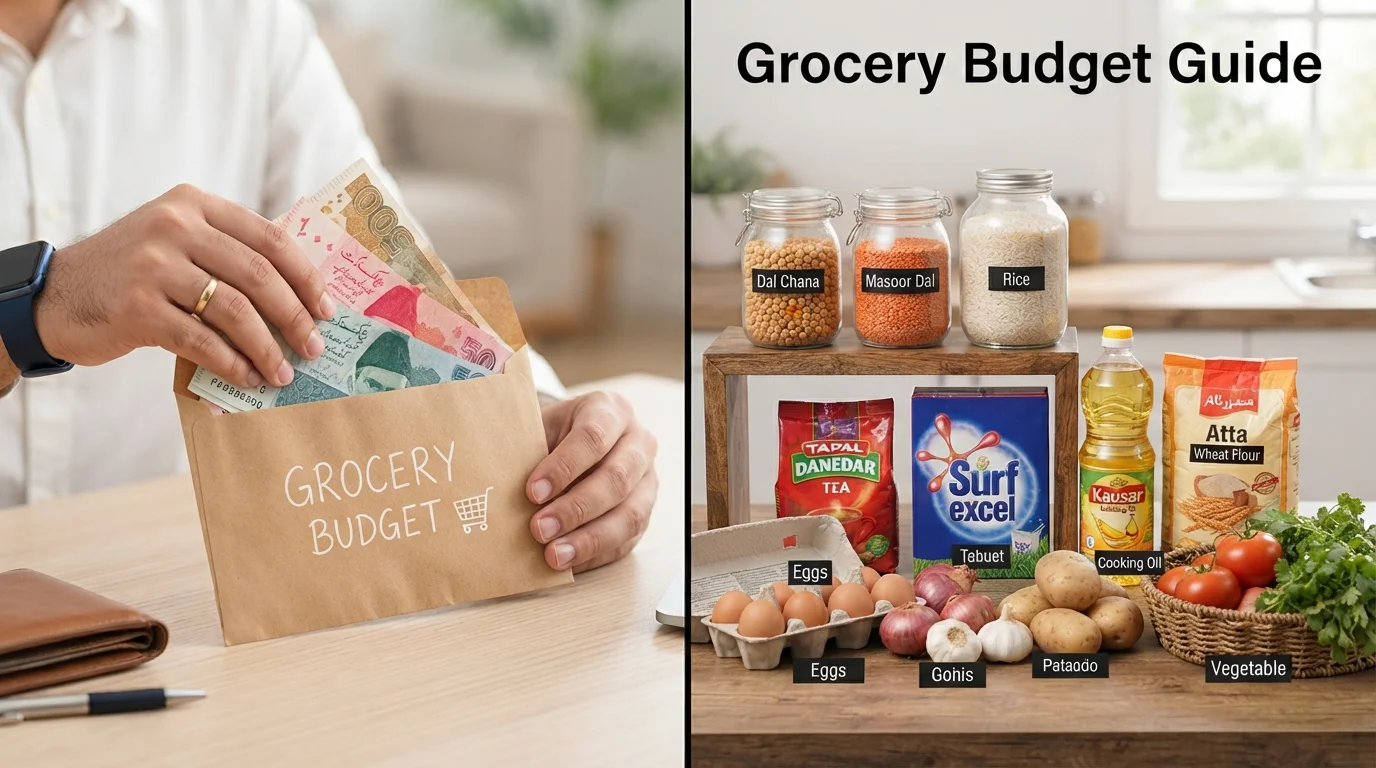
A grocery budget in Pakistan depends on more than the number of people in a household. Food preferences, family size, city, shopping habits, meat and dairy consumption, brands, and where you shop can all change the monthly total.
For a family, it is more useful to build a grocery budget around actual household needs than to follow one fixed number. A household that buys mostly basic staples from a local market will have a very different bill from one that regularly purchases branded packaged foods, premium products, meat, snacks and household supplies from supermarkets.
Recent official data also shows why a single figure can be misleading. Pakistan Bureau of Statistics (PBS) reported average monthly household consumption expenditure of Rs. 79,150 in HIES 2024–25, but this covers overall household consumption rather than groceries alone. Food and non-alcoholic beverages represented 36.72% of household expenditure under the HIES classification.
This guide explains how to build a realistic monthly grocery budget in Pakistan and how to adjust it for your own family.
What Is a Reasonable Grocery Budget in Pakistan?
There is no official nationwide grocery budget that applies equally to every family.
As a practical planning framework, a family can start by setting a monthly food-and-grocery allowance according to its size and eating pattern:
| Household | Basic grocery planning | More varied grocery shopping |
|---|---|---|
| 1–2 people | Rs. 15,000–25,000 | Rs. 25,000–35,000+ |
| 3–4 people | Rs. 25,000–40,000 | Rs. 40,000–55,000+ |
| 5–6 people | Rs. 35,000–50,000 | Rs. 50,000–70,000+ |
| 7+ people | Rs. 45,000+ | Rs. 65,000+ |
These are planning ranges, not government-set amounts or national averages. They are intended as a starting point for budgeting. Actual spending can fall below or above them depending on food choices, local prices, household size, and how much meat, dairy, snacks, and packaged food a family buys.
A family that eats meat frequently, buys more milk, uses branded packaged products, or purchases groceries from higher-priced retailers may need a larger budget.
Why Grocery Costs Differ So Much Between Families
Two households with four people can have completely different grocery bills.
The biggest factors are usually:
Family size
More household members generally mean higher spending on staples such as flour, rice, pulses, milk, vegetables, cooking oil, tea, and other everyday foods.
The latest HIES recorded Pakistan’s average household size at 5.98 people in 2024–25. The average was 5.69 in urban areas and 6.18 in rural areas.
This matters when looking at household expenditure figures because a national household average is not the same thing as the budget required by a family of four.
Eating habits
A household that cooks most meals at home may spend differently from one that regularly buys prepared food.
Meat, dairy, bakery products, snacks, beverages, and packaged foods can make a noticeable difference to the monthly bill.
City and local market
Prices are not identical throughout Pakistan.
For example, Punjab’s notified commodity rates can differ by district, while individual retailers can charge different prices for branded products and packaged goods. The Punjab Food, Civil Supplies & Consumer Protection Department’s September 25, 2026 rate table lists separate district-level rates for items including atta, pulses, milk, rice, sugar, vegetable ghee, chicken and eggs.
Brand choices
A household buying branded tea, cooking oil, cereal, sauces, detergent and other packaged products may spend more than a household purchasing loose or lower-cost alternatives.
This does not automatically mean that one option is better. The important point for budgeting is to compare the actual price, quantity and product type.
Shopping location
Kiryana stores, supermarkets, cash-and-carry stores, wholesale markets and online grocery services may have different prices and promotions.
The same product can also have different prices at different retailers.
What Should a Monthly Grocery Budget Include?

Before setting a number, decide what you mean by “groceries.”
A useful household grocery budget can include:
- Atta and flour
- Rice
- Daal and pulses
- Cooking oil or ghee
- Sugar
- Salt
- Tea
- Spices and masalas
- Milk
- Eggs
- Vegetables
- Fruits
- Chicken, beef or mutton
- Bread and breakfast items
- Biscuits and snacks
- Sauces and cooking ingredients
- Basic packaged foods
You can keep household cleaning products in a separate category if you want a clearer picture of how much your family actually spends on food.
Items such as electricity, gas, school expenses, rent, transport, restaurant meals, and medical costs should not be mixed into a grocery-only budget.
A Simple Monthly Grocery Budget Structure
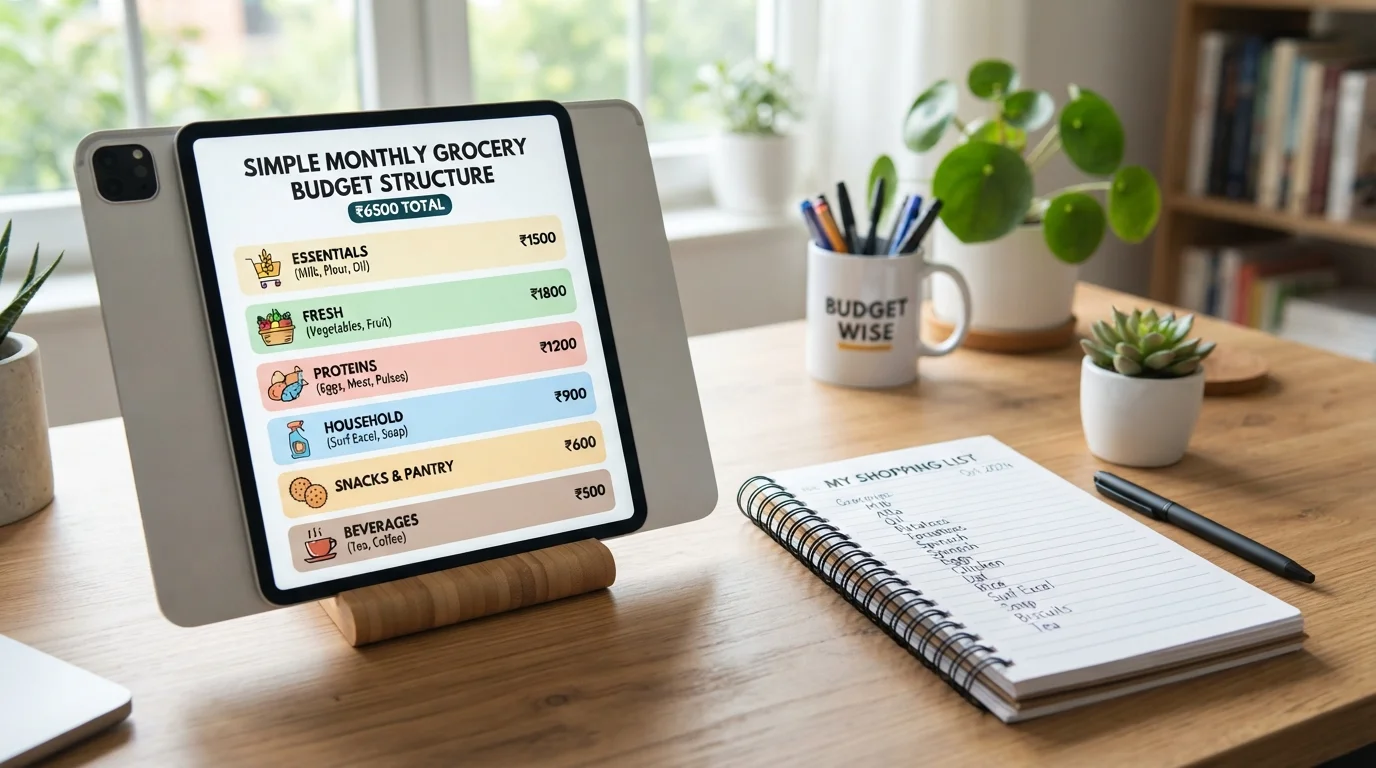
Instead of assigning the whole amount to one shopping trip, divide the budget into categories.
For example, a family could structure its monthly allowance like this:
| Category | Suggested share of grocery budget |
|---|---|
| Atta, rice, daal and other staples | 20–25% |
| Milk, eggs and other dairy | 15–20% |
| Meat and other protein foods | 15–25% |
| Vegetables and fruits | 15–20% |
| Oil, ghee, sugar, tea and spices | 10–15% |
| Snacks, breakfast and packaged foods | 5–10% |
| Small price changes/emergency grocery allowance | 5% |
These percentages are a budgeting framework, not official Pakistani household spending shares. Your family’s actual allocation should reflect what you normally eat.
For example, a vegetarian household may allocate less to meat and more to pulses, vegetables, and dairy. A family that purchases meat several times a week may need considerably more in that category.
What Does Official Pakistani Data Tell Us About Food Spending?
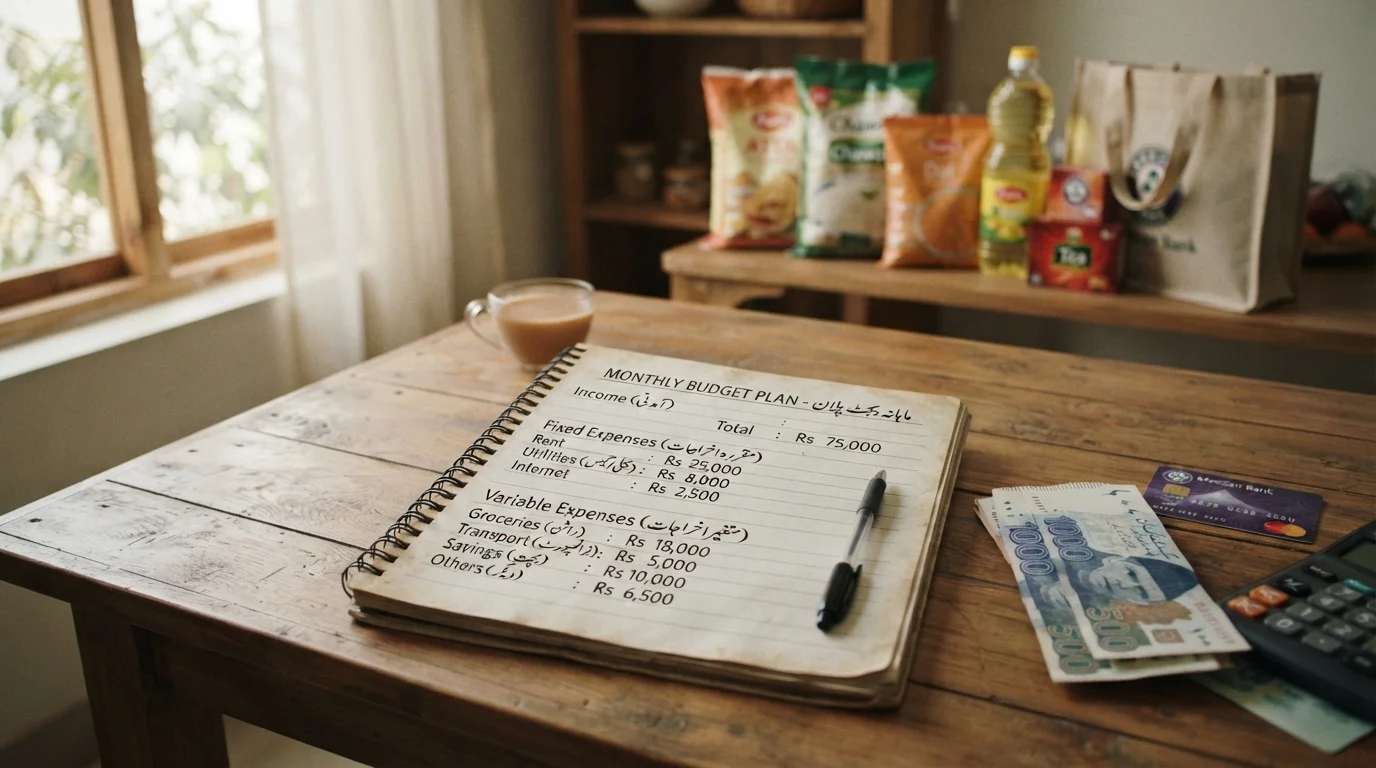
The latest HIES 2024–25 provides useful context for household budgeting.
PBS reported average monthly household consumption expenditure of:
- Rs. 79,150 nationally
- Rs. 95,533 in urban areas
- Rs. 67,894 in rural areas
These figures represent total household consumption, not grocery spending alone.
Food and non-alcoholic beverages were the largest household expenditure category in the HIES classification, accounting for 36.72% in 2024–25. Housing, water, electricity, gas and other fuels accounted for 25.72%.
This provides useful context: food is a major part of household spending, but the household’s complete consumption budget includes many other expenses.
Current Food Prices Can Change the Budget Quickly
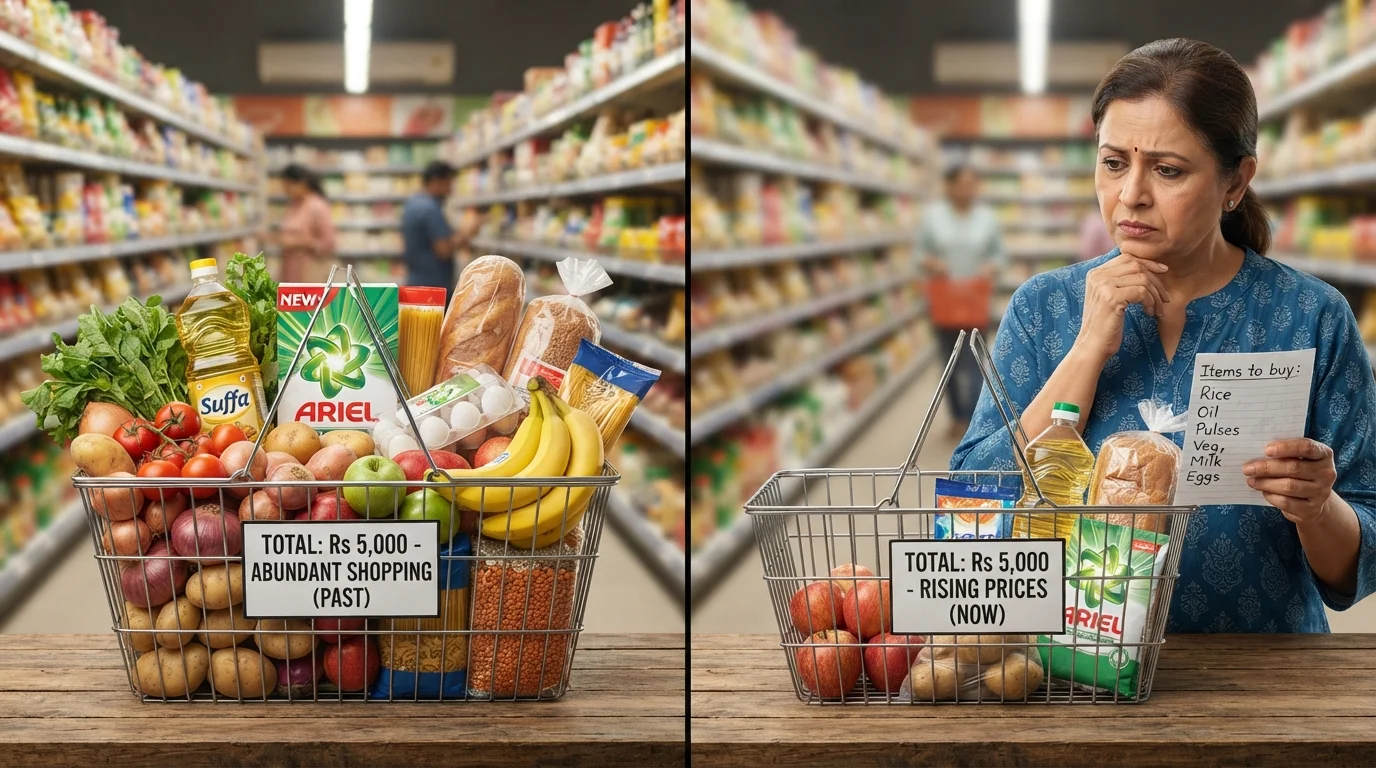
A grocery budget should be reviewed regularly because food prices move over time.
For example, the Punjab government’s Lahore rate information dated September 28, 2026 listed:
- Atta: Rs. 2,200 for a 20kg bag
- Moong pulse: Rs. 280/kg
- Gram pulse: Rs. 220/kg
- Mash pulse: Rs. 410/kg
- Masoor pulse: Rs. 210/kg
- Milk: Rs. 170/litre
- Rice Basmati New: Rs. 310/kg
- Sugar: Rs. 156/kg
- Vegetable ghee: Rs. 550/kg
- Eggs: Rs. 262/dozen
- Chicken meat: Rs. 476/kg
These are notified Lahore rates for the date shown, not fixed prices that every shop must charge for every brand or product.
PBS also reported that the national weekly Sensitive Price Indicator for the week ending September 24, 2026 increased 0.99% from the previous week. The SPI tracks 51 essential items and is designed to monitor short-term price movements.
That is why a grocery budget should have some room for price changes rather than being built around a fixed bill that never changes.
How Much Should a Family of Four Budget for Groceries?
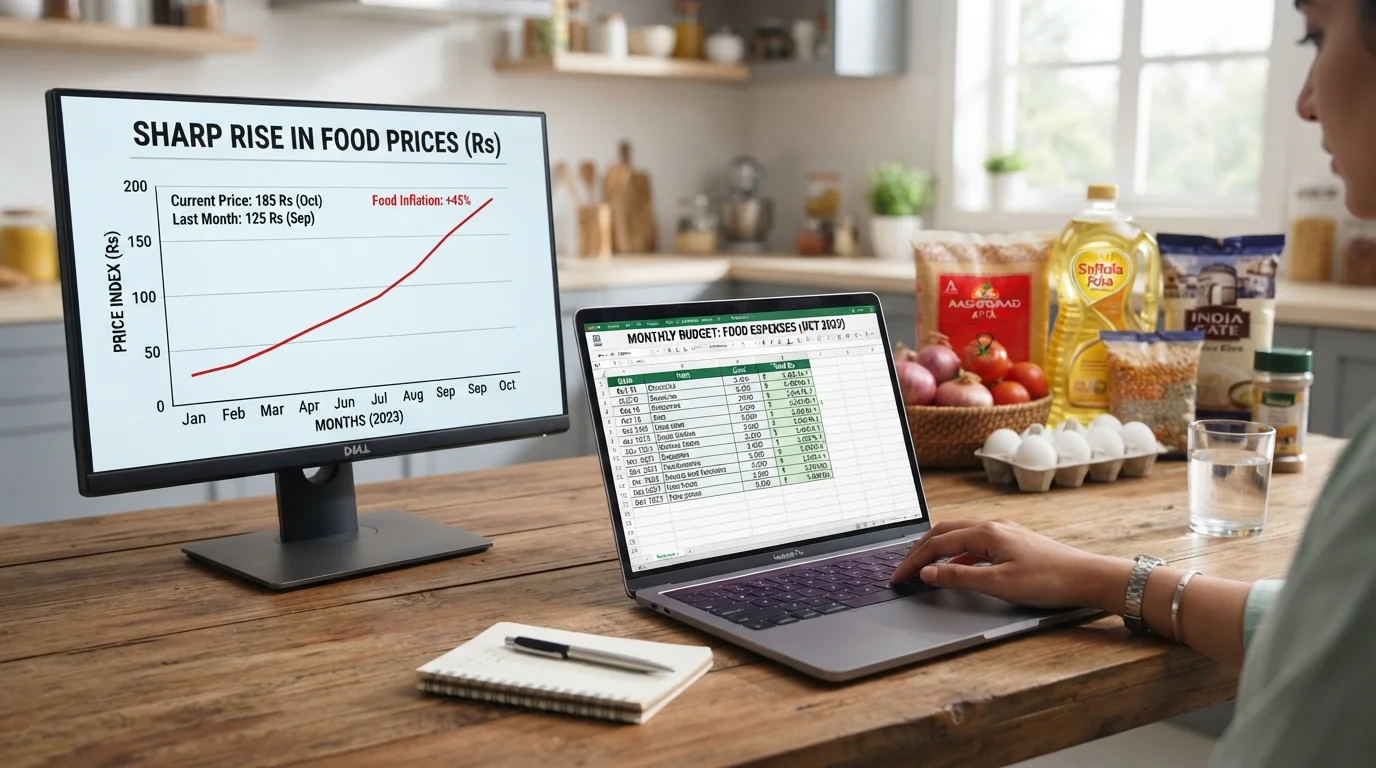
For a family of four, a practical starting point is to separate the budget into three levels.
Basic home-cooking budget
Around Rs. 25,000–35,000 per month
This may work as a starting framework for a household that:
- cooks most meals at home
- focuses on basic staples
- controls snacks and packaged foods
- compares prices before buying
- purchases meat selectively
- avoids unnecessary premium products
The actual amount can still vary substantially by city and food consumption.
Moderate grocery budget
Around Rs. 35,000–50,000 per month
This gives more room for:
- regular meat and chicken
- more dairy
- fruit and vegetables
- branded grocery products
- breakfast items
- snacks
- household food variety
For many families, this is a more flexible planning range if the grocery budget includes a broad mix of everyday foods.
Higher grocery budget
Rs. 50,000+ per month
A higher budget may be appropriate when a household regularly buys:
- larger quantities of meat
- premium brands
- imported or specialty foods
- packaged snacks and drinks
- more dairy products
- convenience foods
- higher-cost household grocery products
The important point is not whether a family spends more or less than another family. The useful question is whether the amount matches its income, household size, and actual needs.
A Better Way to Set Your Own Grocery Budget
Rather than choosing a number from a general article, use your own spending history.
Step 1: Check the last three months
Collect receipts, bank transactions, online orders, and cash purchases.
Add up your grocery spending for each month.
For example:
| Month | Grocery spending |
|---|---|
| Month 1 | Rs. 38,500 |
| Month 2 | Rs. 41,200 |
| Month 3 | Rs. 39,800 |
Average:
Rs. 39,833 per month
That gives you a much more useful starting point than a generic internet estimate.
Step 2: Separate food from household products
Create two totals:
Food
- Atta
- Rice
- Daal
- Meat
- Milk
- Eggs
- Vegetables
- Fruits
- Oil/ghee
- Tea
- Sugar
- Spices
Household
- Laundry detergent
- Dishwashing products
- Cleaning products
- Tissue
- Kitchen supplies
This makes it easier to understand where the money is actually going.
Step 3: Identify your expensive categories
Look at your spending and ask:
- Is meat taking a large share?
- Are snacks and drinks increasing the bill?
- Are branded products costing substantially more?
- Are frequent small shopping trips adding unnecessary items?
- Are you buying larger packs because they are genuinely cheaper per unit?
The answer will show you where your budget needs adjustment.
Weekly Grocery Budget vs Monthly Grocery Budget
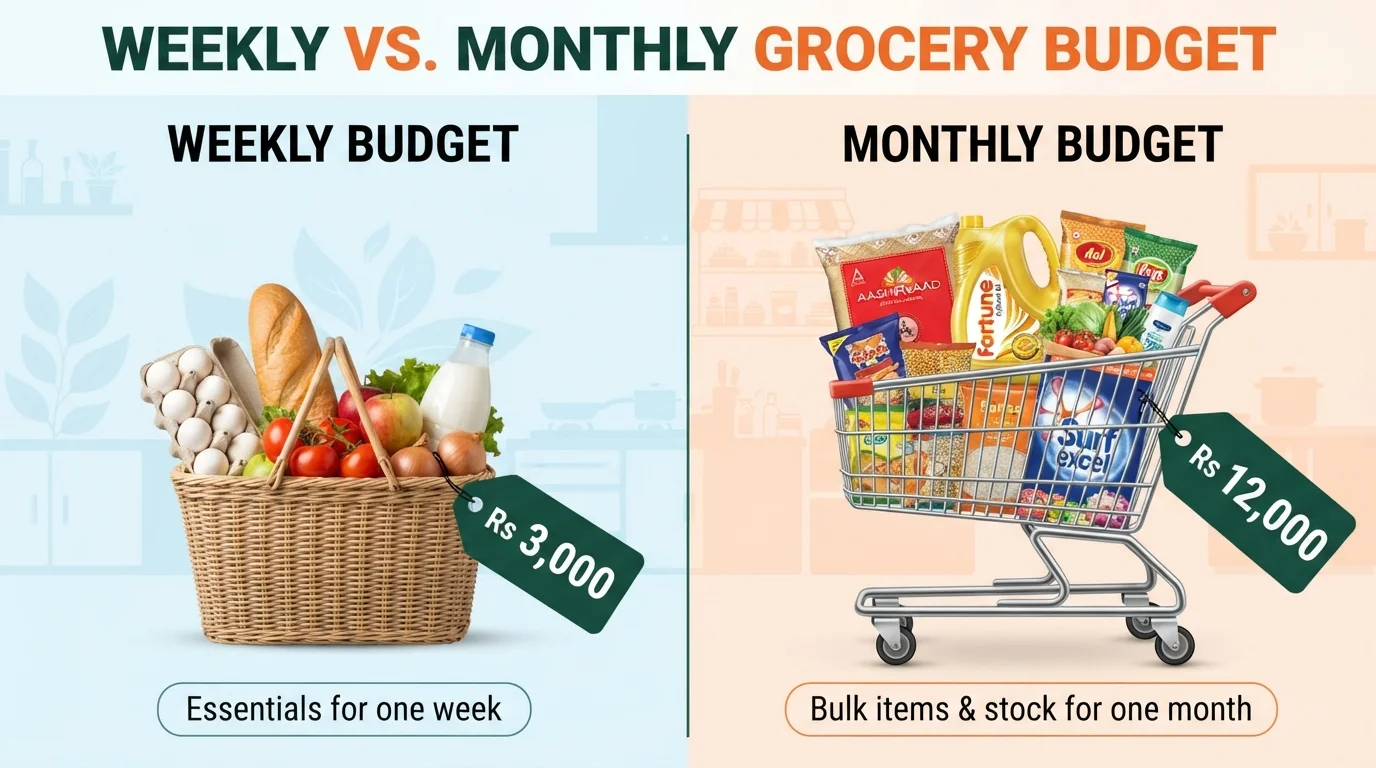
A monthly budget does not mean you have to do one large shopping trip.
A useful system is:
Monthly:
Buy longer-lasting staples such as atta, rice, daal, oil, sugar, tea, and selected household products.
Weekly:
Buy vegetables, fruits, milk, eggs, bread, and other frequently consumed items.
As needed:
Buy meat and other products according to your family’s meal plan and storage capacity.
If your monthly grocery target is Rs. 40,000, you could divide it into approximately Rs. 10,000 per week as a tracking limit. This does not mean spending exactly Rs. 10,000 every week; some months have larger bulk purchases and some weeks require fewer purchases.
How to Keep a Grocery Budget Under Control
A good grocery budget is not simply about buying the cheapest product.
Instead:
Compare prices by quantity
A 500g packet and a 1kg packet should not be compared only by their shelf price.
Calculate the price per kilogram, litre or 100g where appropriate.
Our guide on How to Compare Grocery Prices Before Shopping covers this method in more detail.
Plan before entering the store
A shopping list reduces the chance of repeatedly buying items that were not part of the household’s actual needs.
The Monthly Grocery List for Pakistani Families can be used as a starting checklist.
Keep core pantry items stocked
Items such as atta, rice, pulses, oil, spices, and tea are easier to manage when you know how much your family normally uses.
See the Pakistani Pantry Staples: What to Keep at Home guide for a more detailed pantry approach.
Track price changes
Do not assume that last month’s price is still valid.
For essential commodities, official price statistics can provide useful market context. PBS collects price data across urban and rural markets, while the weekly SPI tracks 51 essential items across 17 cities.
Use the grocery budget as a ceiling, not a target.
If your family needs Rs. 32,000 worth of groceries in a month, spending Rs. 40,000 simply because the budget allows it defeats the purpose of budgeting.
The objective is to understand your normal requirement and keep spending predictable.
Should Grocery Budget Be Based on Income?
Income is an important consideration, but there is no universal percentage that works for every Pakistani household.
HIES 2024–25 reported an average monthly household income of Rs. 82,179 nationally, with Rs. 96,767 for urban households and Rs. 72,157 for rural households. At the same time, household income varies considerably across consumption quintiles.
Therefore, two families with the same number of members may have very different reasonable grocery budgets.
A household should consider:
- monthly take-home income
- rent or housing costs
- utilities
- school and education expenses
- transport
- medical expenses
- debt obligations
- savings
- number of household members
- food preferences
Grocery spending should fit within the household’s overall financial plan rather than being treated as an isolated number.
Grocery Budget for Different Family Sizes
A simple way to adapt your budget is to start with your normal four-person budget and then adjust it according to actual household members.
For example, if a family of four normally spends Rs. 40,000, a family of two will not necessarily spend exactly Rs. 20,000.
Some expenses do not decrease proportionally with household size. A bottle of cooking oil, a packet of spices or a bag of flour can serve different household sizes for different periods.
Children also have different food requirements from adults.
For this reason, per-person calculations are useful for comparison, but actual household budgeting should be based on consumption patterns.
What the HIES Food Data Can Tell You
The HIES 2024–25 also provides per-capita quantities for major food items.
For the national total, monthly per-capita quantities reported for 2024–25 included approximately:
- Wheat and wheat flour: 6.59 kg
- Rice and rice flour: 0.86 kg
- Pulses: 0.26 kg
- Fresh and boiled milk: 6.15 litres
- Cooking oil: 0.28 litres
- Chicken meat: 0.34 kg
- Eggs: 2.83
- Potatoes: 1.17 kg
- Tomatoes: 0.59 kg
- Onions: 0.85 kg
- Sugar: 1.22 kg
- Tea: 81.47 grams
These are survey consumption quantities, not a recommended shopping list. Actual requirements can differ significantly by family, diet, and household composition.
For budgeting, this data is useful as a reference point rather than a rule.
Grocery Budget vs Overall Household Spending
One common budgeting mistake is treating the grocery bill as the family’s entire food budget.
A family may also spend money on:
- restaurant meals
- takeaway
- school lunches
- office meals
- bakery purchases
- food delivery
- bottled drinks
- special occasions
If these expenses are not included in your grocery total, your household may appear to be spending less on food than it actually is.
For a realistic household budget, track groceries and eating out separately.
How Grocer.pk Can Help With Grocery Planning
A grocery budget becomes more useful when you know where you can shop and compare available options.
Grocer.pk organizes grocery businesses by categories such as supermarkets, grocery stores, Kiryana stores, and online grocery stores. This can help shoppers identify stores in their city or area before making a shopping trip.
For Lahore shoppers, the Grocery Stores in Lahore by Area guide can also help when comparing nearby shopping options.
The purpose is not simply to find the lowest listed price. A nearby store, a trusted retailer, product availability, pack size, and travel cost can all affect the real value of a purchase.
A Simple Monthly Grocery Budget Checklist
Before starting a new month, check:
- How many people are shopping for?
- What is the monthly grocery limit?
- How much was spent last month?
- Which staples need restocking?
- How much meat is expected this month?
- How much milk is normally used?
- Which vegetables and fruits are purchased weekly?
- Are tea, sugar, and oil running low?
- Which household products need replacing?
- Are any large purchases planned?
- Have current prices been checked?
- Is there a small amount reserved for price changes?
This takes only a few minutes but can make monthly grocery spending much easier to monitor.
Frequently Asked Questions
How much should a family of four spend on groceries in Pakistan?
There is no single correct amount. As a practical planning range, a family of four might start around Rs. 25,000–40,000 for basic-to-moderate grocery shopping and adjust upward for regular meat, higher dairy consumption, branded products, snacks, and other preferences. Actual prices and household needs can make the total considerably different.
What is the average monthly grocery expense in Pakistan?
There is no single official figure for average grocery expense alone. PBS’s HIES 2024–25 reported average monthly household consumption expenditure of Rs. 79,150, but this includes all household consumption categories rather than groceries alone. Food and non-alcoholic beverages accounted for 36.72% of household expenditure in the HIES classification.
How much should a family of five spend on groceries?
A family of five may need roughly Rs. 35,000–50,000 or more as a starting planning range, depending on its food choices and location. Families with higher meat, dairy, packaged-food, or premium-brand consumption may spend more.
How can I reduce my monthly grocery bill?
Start by tracking three months of spending, comparing unit prices, planning purchases, reducing unnecessary impulse buying, and reviewing expensive categories. Buying the cheapest product is not always necessary; understanding where the money is going is more useful.
Should household cleaning products be included in the grocery budget?
They can be, but keeping them as a separate category often makes the budget easier to understand. Food spending and household cleaning expenses behave differently and can be tracked independently.
Why does my grocery budget change every month?
Food prices, seasonal produce, family events, guests, bulk purchases, meat consumption, and changing household needs can all affect the monthly total. Pakistan’s official price statistics also show that essential commodity prices can change from week to week.
Final Takeaway
A useful grocery budget in Pakistan is not one fixed number copied from a national average. It is a spending limit built around your family’s actual size, eating habits, location, and income.
For a family of four, Rs. 25,000–40,000 can be used as a starting planning range for basic-to-moderate grocery shopping, while households with more meat, dairy, packaged foods, or premium products may require considerably more.
The most reliable method is simple: track what your family actually buys, compare current prices, separate food from household products, and review the budget every few months.
Official HIES data can provide national context, while current commodity and market prices help you adjust the budget to present-day conditions. Together, these are more useful than treating any single monthly amount as the “correct” grocery budget for every Pakistani family.