Jaggery (Gur) in Pakistan: Types, Uses and Buying Guide
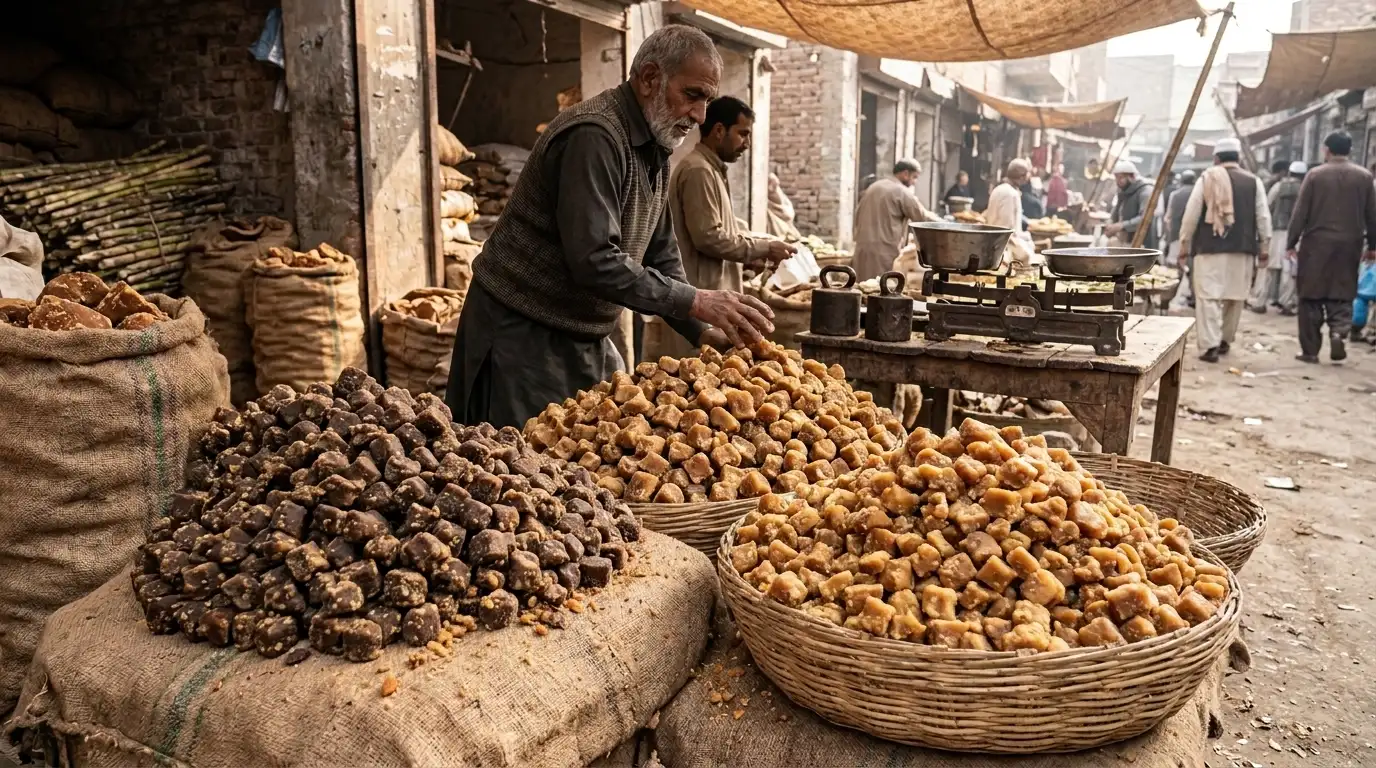
Gur, commonly known as jaggery in English, is a traditional sweetener used in many Pakistani households. It is made mainly from sugarcane juice and is commonly sold in solid blocks, pieces, and powder-like forms. Its distinctive taste makes it a popular ingredient in traditional sweets, desserts, drinks, and everyday recipes.
Unlike refined white sugar, gur usually retains some of the natural components of sugarcane juice because it undergoes less refining. However, this does not make it a sugar-free or low-calorie food. It is still a concentrated sweetener and should be consumed in moderation.
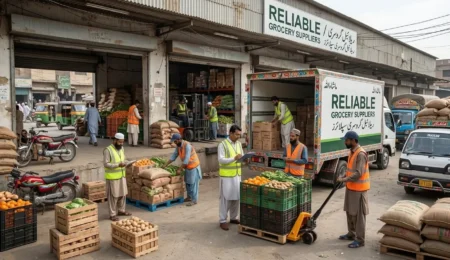
In Pakistan, gur is available through local markets, grocery stores, traditional sweet shops, and some supermarkets. Its colour, texture, taste, quality, and price can vary depending on the sugarcane, production method, processing conditions, and storage.
Understanding the different forms of jaggery and knowing what to check before buying can help you choose a product that suits your cooking needs and budget.
What Is Jaggery? Gur Meaning in Urdu
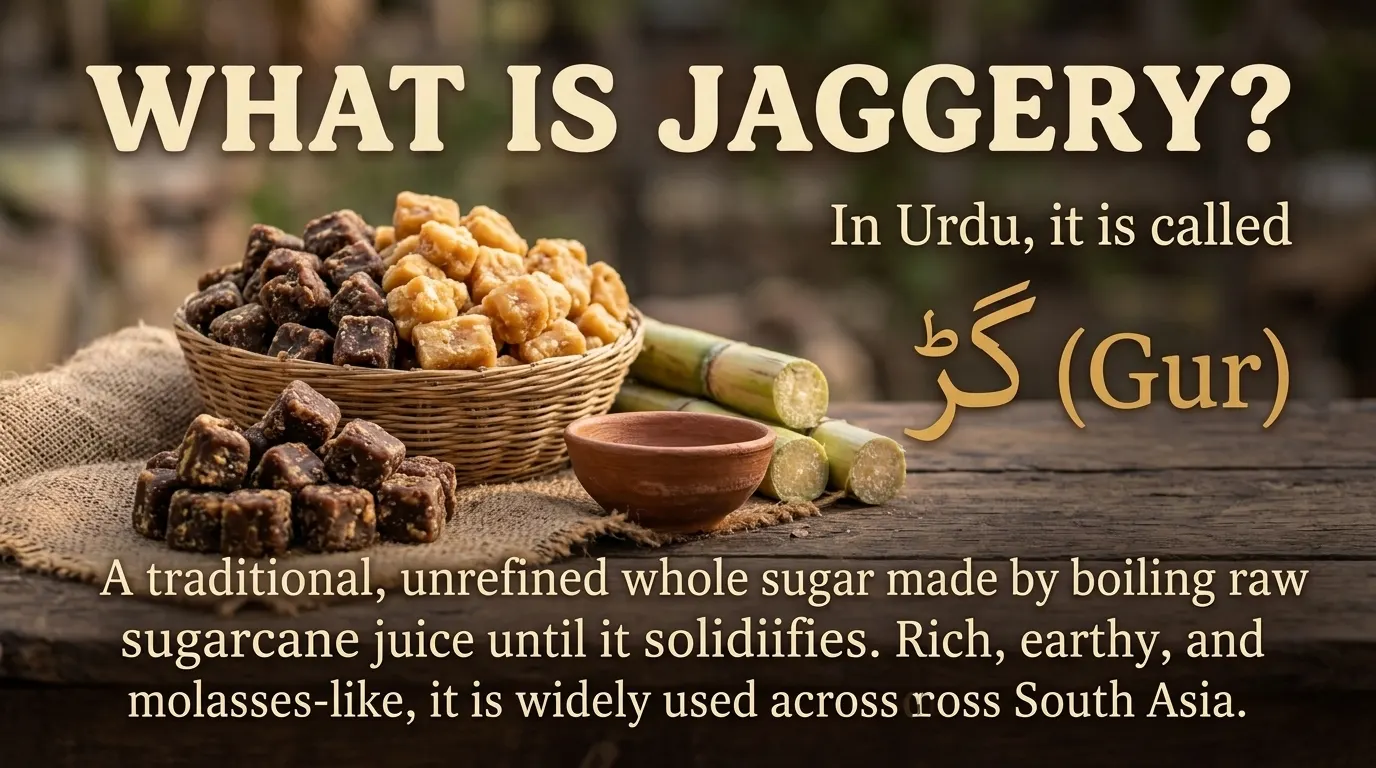
Jaggery is an unrefined or minimally refined traditional sweetener made by concentrating sugarcane juice or, in some regions, the sap of certain palm trees.
In Pakistan, jaggery generally refers to the traditional sweetener made from sugarcane juice.
The Urdu word for jaggery is گڑ (Gur). It is also commonly called gur in Punjabi and other regional languages.
During production, sugarcane is crushed to extract its juice. The juice is filtered, heated, and concentrated until it becomes a thick mass. This mixture is then cooled and shaped into solid pieces, blocks, or other forms.
Gur has a characteristic caramel-like sweetness. Its colour can range from golden yellow and light brown to dark brown, depending on the sugarcane, processing, and storage conditions.
What Is Gur Called in English?
Gur is called jaggery in English.
The terms gur and jaggery generally refer to the same traditional sweetener in the Pakistani grocery market. Jaggery is the more widely used English name, while gur is the familiar local name.
How Is Gur Made in Pakistan?
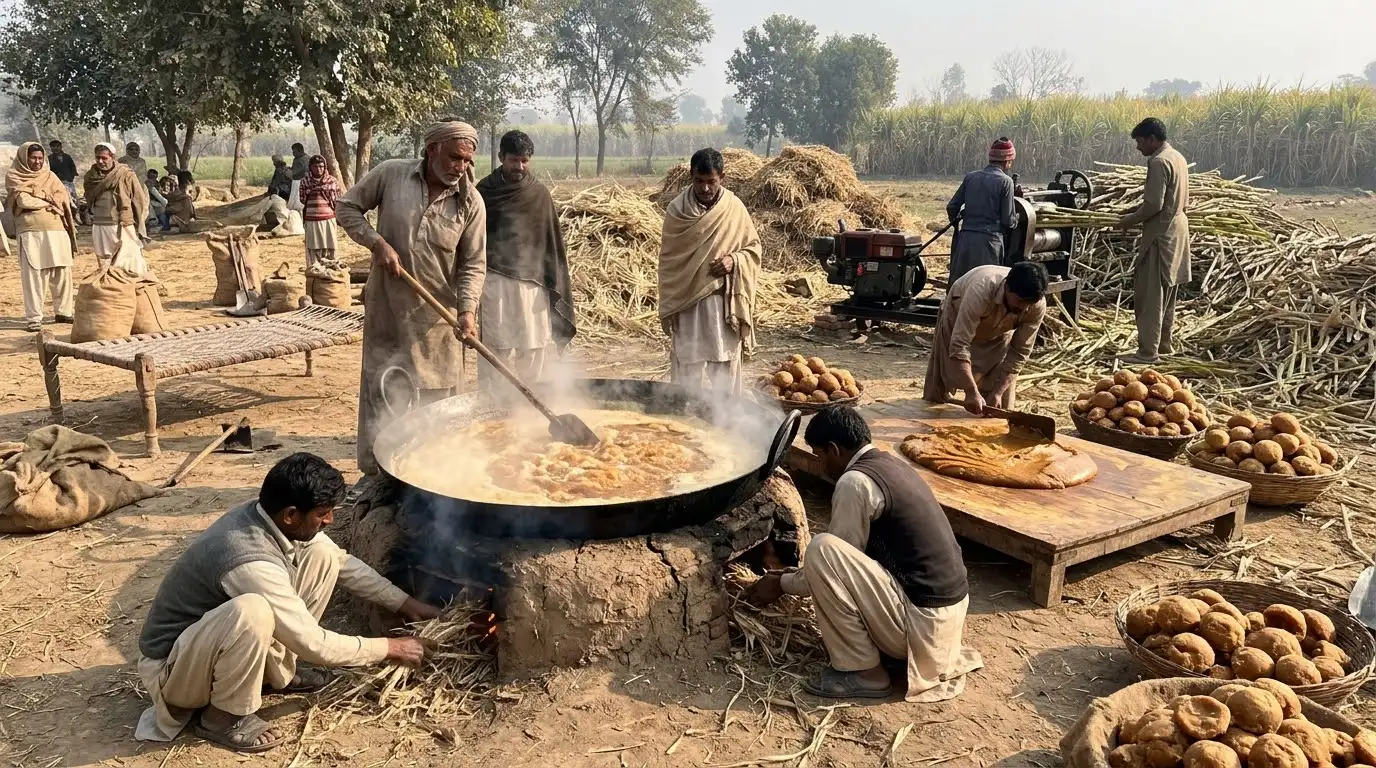
Traditional gur production begins with freshly harvested sugarcane. The process involves extracting the juice, removing suspended impurities, concentrating the liquid through heating, and allowing the thick mixture to cool and solidify.
The main production stages include:
- Sugarcane crushing: Sugarcane stalks are passed through a crusher to extract their juice.
- Juice filtering: The extracted juice is filtered to remove fibrous material and other suspended particles.
- Clarification: The juice is heated, and impurities that rise to the surface are removed during processing.
- Concentration: The clarified juice is boiled to evaporate water and produce a thick, concentrated mixture.
- Cooling and shaping: The concentrated mixture is stirred, cooled, and shaped into blocks, pieces, or other forms.
The Punjab Agricultural Research Board describes these traditional stages in its publication Cane and Sugar Production, including the preparation of gur and shakkar.
The quality of the final product depends on several factors, including sugarcane maturity, juice quality, cleanliness of equipment, processing methods, and storage conditions.
Proper handling is important throughout production. Dirty equipment, unsuitable raw materials, or poor processing conditions can affect the product’s appearance, quality, and keeping properties.
Different Types and Forms of Gur in Pakistan
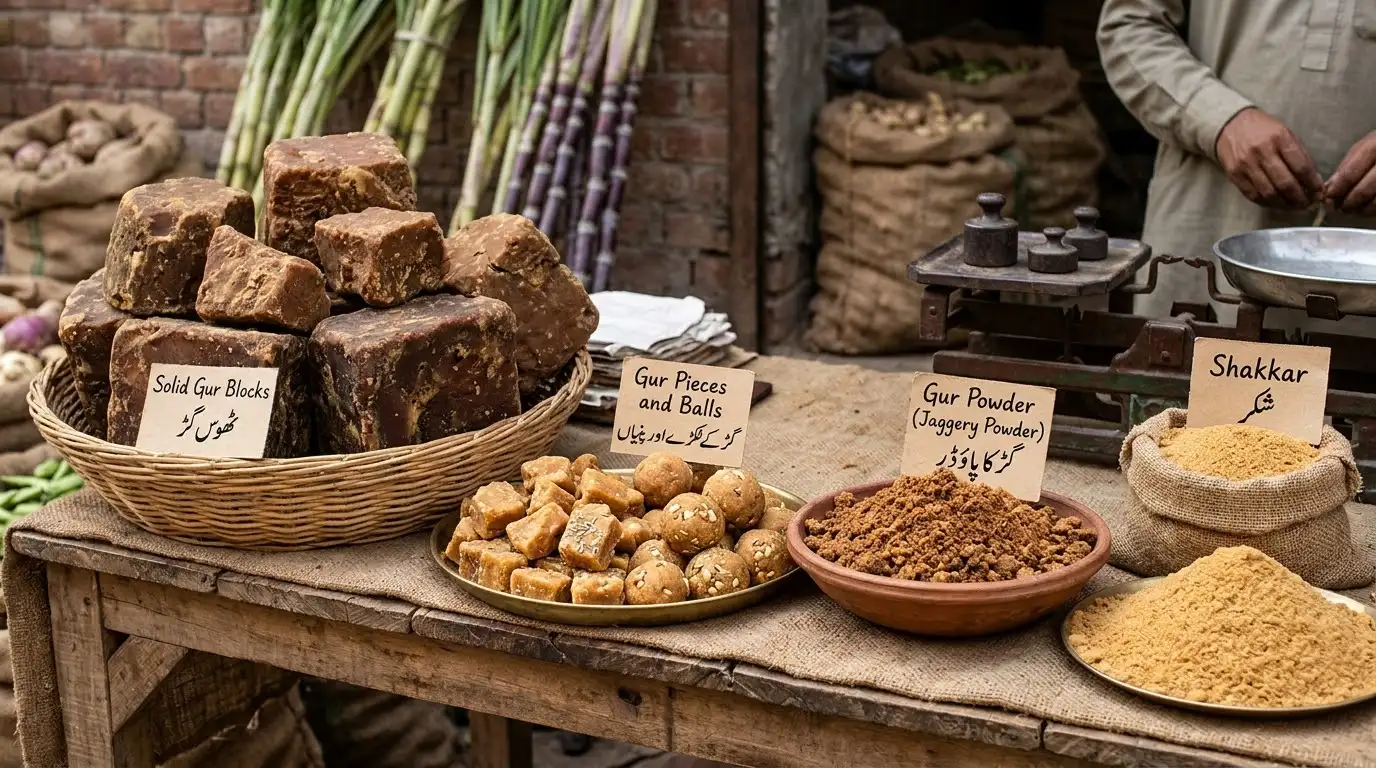
Gur is not always sold in one standard shape or texture. Pakistani markets offer different forms depending on local production methods and how the product is prepared.
The following are some common forms shoppers may come across.
1. Solid Gur Blocks
Solid gur blocks are one of the familiar forms of jaggery in Pakistan.
The concentrated sugarcane mixture is allowed to cool and solidify in moulds or containers. The resulting blocks may be sold whole or broken into smaller pieces.
Solid gur is commonly used for:
- Traditional Pakistani sweets
- Homemade desserts
- Winter drinks
- Gur-based snacks
- Sweetening tea and other beverages
The blocks can vary in size, firmness, colour, and texture.
2. Gur Pieces and Balls
Some producers shape the concentrated mixture into small balls or irregular pieces rather than large blocks.
These forms are convenient when households want to use smaller quantities without breaking a large block.
Gur pieces can be added to recipes, melted into liquids, or eaten as a sweet ingredient. Their size and shape depend on the producer and local market practices.
3. Jaggery Powder (Gur Powder)
Jaggery powder is a loose, granular, or powder-like form of traditional gur.
It is easier to measure and mix than solid blocks because it does not usually require breaking or crushing before use.
Jaggery powder can be used in:
- Tea and hot drinks
- Homemade desserts
- Baking recipes
- Porridge and breakfast preparations
- Traditional sweets
- Recipes that require a loose sweetener
The texture may range from fine powder to coarse granules. Some products sold as shakkar or powdered gur may have a similar appearance, but local naming and processing can vary.
Check the product description and ingredients rather than assuming that every brown powder sold in the market is the same product.
4. Shakkar
Shakkar is a traditional sugar product associated with the processing of sugarcane juice.
It is generally sold in a granular or powder-like form. In traditional production, the concentrated mixture is handled differently from the mixture used to make solid gur, resulting in a more crumbly or granular product.
Shakkar and gur are related traditional sweeteners, but they should not automatically be treated as identical products. Their texture, preparation, and appearance can differ.
When buying, check the product name and ask the seller whether it is solid gur, powdered gur, or shakkar.
Common Uses of Gur in Pakistani Food
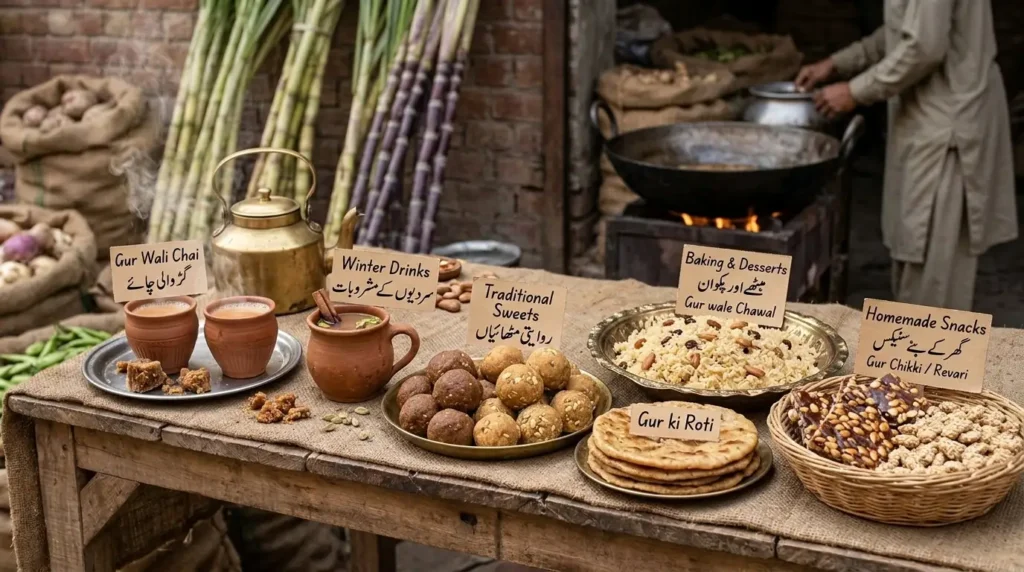
Gur has a distinctive flavour that makes it useful in traditional Pakistani cooking. It is often selected when a recipe needs more than simple sweetness.
Some common uses include:
Traditional Sweets
Gur is used in several traditional sweets and homemade preparations. It can be combined with sesame seeds, peanuts, flour, nuts, and other ingredients to make different sweet dishes.
Gur Wali Chai
Some households use a small amount of gur to sweeten tea instead of refined sugar. It gives the drink a different flavour and colour.
Gur should generally be added according to the recipe or personal taste. Its flavour can be stronger than ordinary white sugar.
Winter Drinks
Gur is used in some traditional winter drinks and homemade preparations. It can be dissolved in warm liquids to add sweetness.
Baking and Desserts
Jaggery powder can be used in selected baking recipes, cookies, cakes, and desserts. However, it may change the colour, moisture, and flavour of the final product.
Recipes developed specifically for white sugar may require adjustments when jaggery is used as a substitute.
Homemade Snacks
Gur is also used in traditional snacks made with peanuts, sesame seeds, nuts, and other ingredients. Its sticky texture helps bind some sweet preparations together.
Jaggery Nutrition and Calories
Jaggery mainly provides carbohydrates and sugars. It may also contain small amounts of minerals because it is less refined than ordinary white sugar.
However, its nutritional composition is not identical across all products. The sugarcane variety, production method, processing, and moisture content can influence the final composition.
Some food composition references report approximately 367 calories per 100 grams of jaggery. This is an indicative figure rather than a guaranteed value for every gur product sold in Pakistan.
| Nutritional component | General information |
|---|---|
| Calories | Approximately 367 kcal per 100 g in one food composition reference |
| Carbohydrates | The main nutritional component |
| Sugars | Present in high amounts |
| Protein | Very small amount |
| Fat | Usually negligible |
| Minerals | May contain small amounts of calcium, potassium, iron, and other minerals |
These values can vary between samples. For accurate nutritional information, use the product’s nutrition label where available.
Is Jaggery Healthier Than White Sugar?
Jaggery is less refined than ordinary white sugar, and it may retain small amounts of minerals. However, this does not mean it is automatically a healthy substitute.
Both gur and white sugar provide concentrated sweetness and calories. The mineral content of jaggery does not remove its high sugar content.
If you are monitoring your daily sugar intake, replacing white sugar with large amounts of gur is not a reliable way to reduce sugar consumption.
Jaggery Benefits: What Does the Evidence Say?
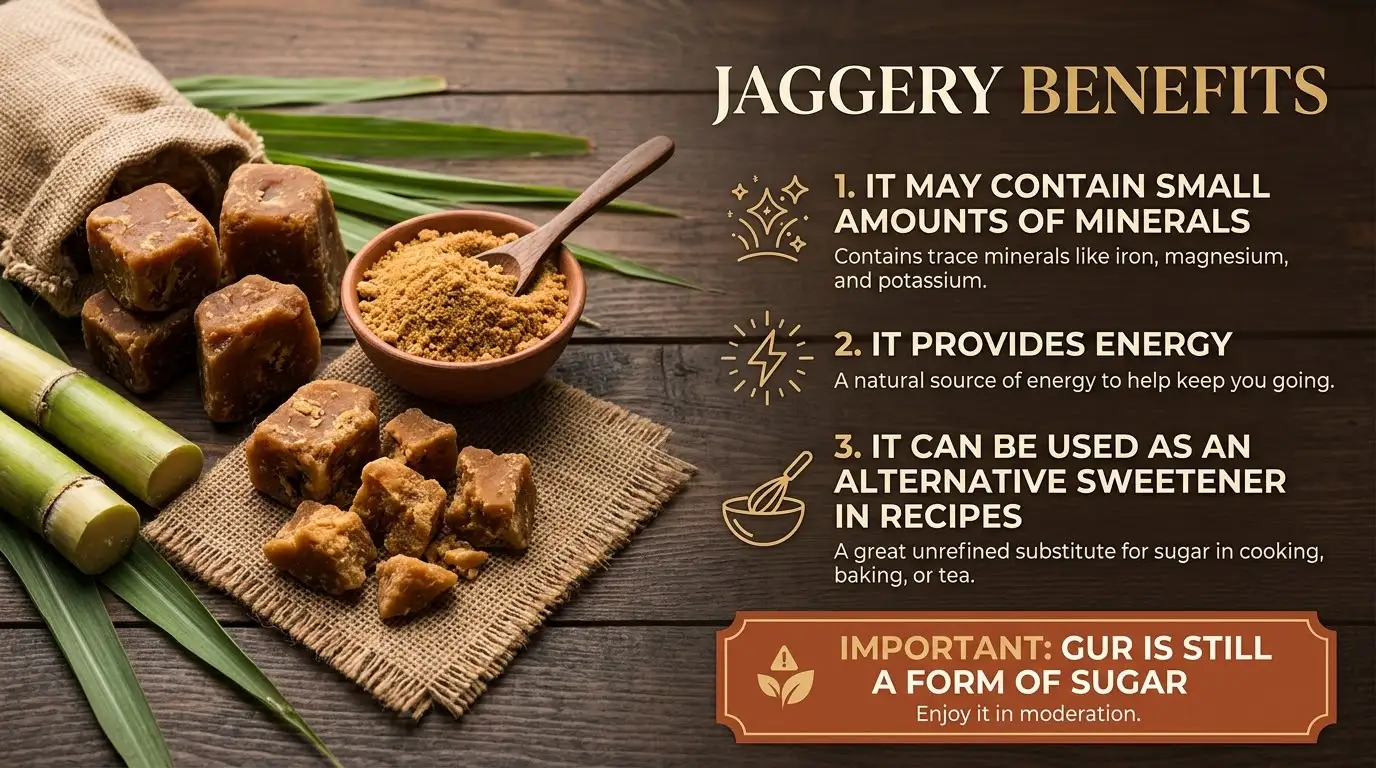
Gur is sometimes promoted as a healthier alternative to white sugar because it is traditionally prepared and may retain some minerals.
There are a few nutritional differences worth understanding, but many health claims about jaggery are exaggerated.
1. It May Contain Small Amounts of Minerals
Compared with highly refined white sugar, jaggery can retain small amounts of minerals such as potassium, calcium, and iron.
However, the quantities vary between products. Gur should not be considered a dependable source of essential minerals or used as a replacement for a balanced diet.
2. It Provides Energy
Like other sugar-based sweeteners, jaggery provides carbohydrates that the body can use for energy.
However, this is not a unique health benefit. White sugar and other carbohydrate-rich foods also provide energy.
3. It Can Be Used as an Alternative Sweetener in Recipes
Gur has a different flavour from refined sugar. Some people prefer it in traditional drinks, sweets, and homemade recipes.
Its value in cooking is mainly related to taste and the type of preparation rather than proven medicinal effects.
Important: Gur Is Still a Form of Sugar
Jaggery should not be described as a treatment for digestive problems, anaemia, or other medical conditions.
It is also not a diabetes-friendly substitute for ordinary sugar. People managing diabetes or blood glucose levels should account for the carbohydrates and sugars in gur just as they would with other sweeteners.
Jaggery vs Sugar: What Is the Difference?
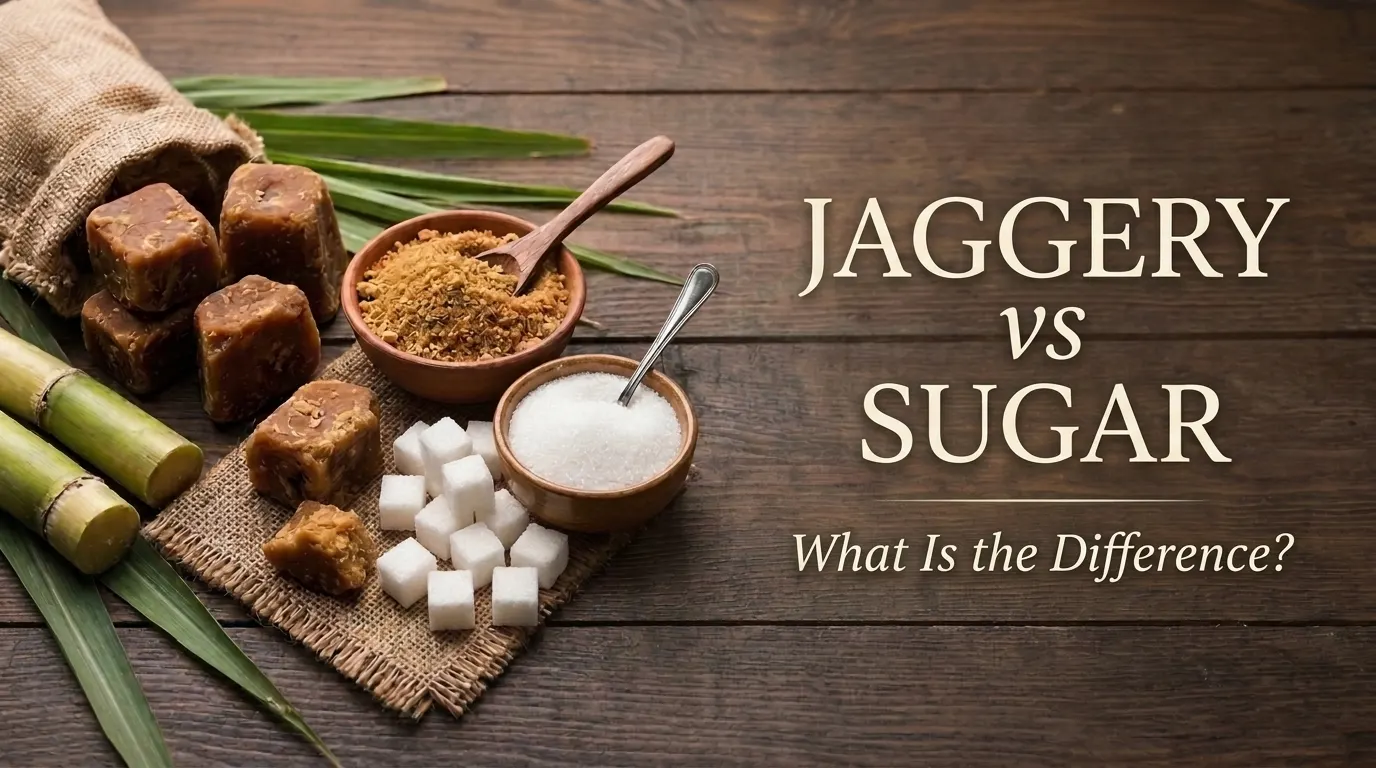
Gur and refined white sugar are both sweeteners, but they differ in processing, appearance, flavour, and texture.
White sugar is processed to produce a more refined crystalline product. Gur is made by concentrating sugarcane juice and allowing it to solidify without the same level of refining.
| Feature | Jaggery (Gur) | White Sugar |
|---|---|---|
| Main source | Commonly sugarcane juice in Pakistan | Commonly sugarcane or sugar beet |
| Processing | Concentrated and solidified | Refined and crystallised |
| Appearance | Golden, light brown, or dark brown | White crystals |
| Texture | Blocks, pieces, or powder-like forms | Granulated crystals |
| Flavour | Caramel-like and distinctive | Relatively neutral sweetness |
| Minerals | May retain small amounts | Very little |
| Uses | Traditional sweets, drinks, and selected recipes | Tea, drinks, cooking, and baking |
| Calories | High | High |
Which Is Better: Gur or Sugar?
The better option depends on what you are preparing and what flavour you prefer.
Gur is useful when a recipe calls for its distinctive taste, while refined sugar is more suitable when a neutral sweetness or consistent crystalline texture is needed.
From a nutritional perspective, neither should be treated as a food that can be consumed without considering sugar intake. Jaggery is not automatically a healthier choice simply because it is less refined.
For a broader explanation of different sugar varieties available in Pakistan, see our guide to sugar in Pakistan, including its types and uses.
How to Identify Good-Quality Gur
Choosing good-quality gur requires more than looking at its colour. Products can vary naturally, and appearance alone cannot confirm purity or food safety.
Before buying, consider the following points.
Check the Appearance
Look for gur that appears reasonably consistent with the product being sold. Excessive visible dirt, foreign particles, or unusual contamination are reasons to avoid a product.
Do not assume that lighter gur is always pure or that darker gur is always poor quality. Colour can vary because of sugarcane, processing, and storage conditions.
Check the Smell
Good-quality gur generally has a characteristic sweet, caramel-like aroma.
Avoid products with a musty, mouldy, chemical, or otherwise unpleasant smell.
Examine the Texture
Gur can naturally be soft, firm, crumbly, or hard depending on its moisture content and form.
However, excessive moisture, sticky patches, visible mould, or unusual deterioration may indicate unsuitable storage or poor product quality.
Look for Foreign Material
Check the product for visible dirt, insects, fibres, stones, or other unwanted material.
For packaged gur, inspect the packet and its contents before use. Avoid products with damaged or poorly sealed packaging.
Buy from a Reliable Seller
Choose a grocery store, supermarket, or supplier that maintains clean storage conditions and can provide basic product information.
For packaged products, check the manufacturer’s name, ingredients, net weight, and other available label details.
If a seller makes claims such as organic, chemical-free, or pure, ask whether the claim is supported by reliable information rather than relying only on packaging or verbal assurances.
How to Choose and Buy Gur in Pakistan
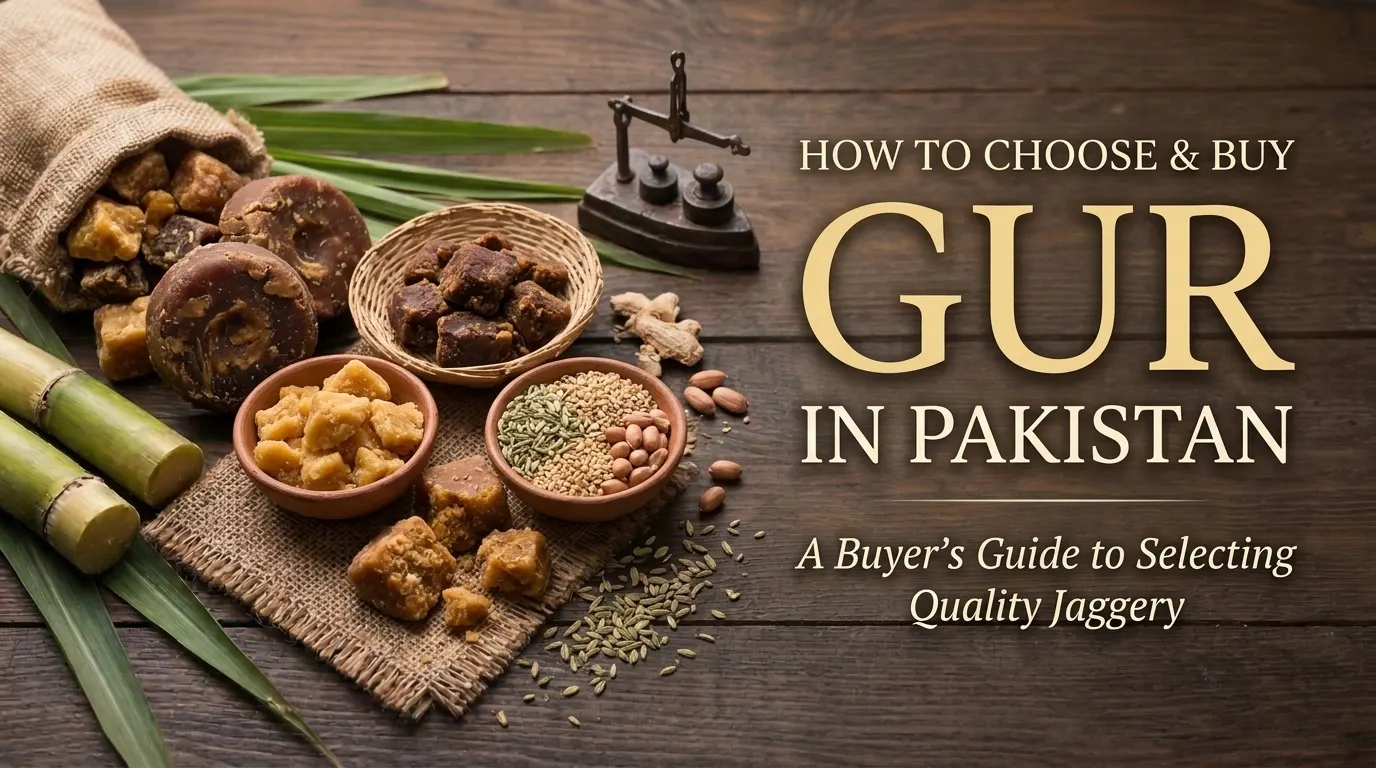
Gur is sold through traditional markets, grocery stores, Kiryana stores, sweet shops, and some supermarkets.
Your choice should depend on how you plan to use it.
For Traditional Sweets
Solid blocks or pieces may be suitable for recipes that require gur to be melted or crushed before mixing.
For Tea and Drinks
Small pieces or jaggery powder can be more convenient because they are easier to measure and dissolve.
For Baking
Jaggery powder may be easier to incorporate into certain baking mixtures. However, check whether the recipe is designed for jaggery or whether adjustments are needed.
For Regular Household Use
Consider the quantity your household actually consumes. Buying a large amount is not necessarily economical if the product is likely to absorb moisture or deteriorate before it is used.
Check the Price per Kilogram
Different sellers may offer different pack sizes and product forms. Compare the price per kilogram rather than comparing only the total packet price.
Also consider the quality, packaging, and seller’s storage conditions before making a decision.
Gur Price in Pakistan
The price of gur in Pakistan can vary according to the city, market, season, product quality, form, and seller.
Solid gur, powdered gur, and branded packaged products may not have the same price. Retail prices can also differ from wholesale or mandi rates.
According to the Pakistan Bureau of Statistics (PBS), the average price of one kilogram of average-quality gur was Rs. 226.38 during the week ended 12 November 2026.
The PBS report recorded the following comparison:
| Period | Average price per kg |
|---|---|
| 12 November 2026 | Rs. 226.38 |
| 5 November 2026 | Rs. 227.72 |
| 13 November 2025 | Rs. 242.45 |
These are reported average prices for average-quality gur, not guaranteed retail prices at every grocery store. A specific shop may charge more or less depending on its location, product quality, and selling conditions.
For the latest available official price information, check the Pakistan Bureau of Statistics weekly Sensitive Price Indicator.
When comparing gur prices, consider:
- Whether the product is solid gur or powdered gur
- The actual weight of the packet
- Whether the product is loose or packaged
- Its visible condition and storage
- The seller’s reputation
- The price per kilogram
A lower price does not automatically mean better value if the product has poor quality or unsuitable storage conditions.
How to Store Gur Properly
Gur can absorb moisture from its surroundings, which may affect its texture and storage life.
Proper storage helps maintain its quality for longer.
Follow these basic practices:
- Keep gur in a clean, dry, airtight container.
- Store it away from moisture, steam, and direct sunlight.
- Use a clean and dry spoon when handling powdered gur.
- Avoid mixing fresh gur with old or deteriorated stock.
- Check the product occasionally for mould, insects, unusual smell, or other signs of deterioration.
- Follow the manufacturer’s storage instructions for packaged products.
If gur develops visible mould, an unpleasant smell, or signs of spoilage, do not use it.
Frequently Asked Questions About Gur and Jaggery
What is jaggery called in Urdu?
Jaggery is called gur (گڑ) in Urdu. It is a traditional sweetener commonly made from concentrated sugarcane juice.
What is gur called in English?
Gur is called jaggery in English. Both names generally refer to the same traditional sweetener in Pakistan.
What is jaggery made from?
Jaggery is commonly made by extracting juice from sugarcane, filtering it, heating it to remove water, and allowing the concentrated mixture to cool and solidify. In some other regions, jaggery can also be made from palm sap.
Is jaggery the same as brown sugar?
No. Jaggery and brown sugar are different products with different processing methods, textures, and flavours. Their brown colour does not make them interchangeable.
What is jaggery powder?
Jaggery powder is a loose or granular form of jaggery. It is easier to measure and mix than solid gur and can be used in drinks, desserts, and selected recipes.
Is jaggery powder the same as shakkar?
They may look similar and are sometimes used in related traditional preparations, but the terms can refer to products with different processing methods and textures. Check the product description before buying.
How many calories are in 100 grams of jaggery?
One food composition reference reports approximately 367 calories per 100 grams of jaggery. The exact value can vary depending on the product and its moisture content.
Is gur healthier than white sugar?
Gur may retain small amounts of minerals that are largely absent from refined white sugar. However, it remains a concentrated source of sugar and calories. It should not be considered a health food or a risk-free replacement for white sugar.
Can people with diabetes eat gur?
Gur contains sugars and carbohydrates and can raise blood glucose levels. People with diabetes should not assume it is safer than white sugar. They should follow their individual dietary advice and account for its carbohydrate content.
What is the price of gur in Pakistan?
The price varies by city, product quality, and seller. The PBS reported an average price of Rs. 226.38 per kilogram for average-quality gur during the week ended 12 November 2026. Retail prices may differ.
How should jaggery be stored?
Store jaggery in a clean, dry, airtight container away from moisture and direct sunlight. Check it regularly for mould, insects, unusual smells, or other signs of spoilage.
Final Thoughts
Gur is a familiar traditional sweetener in Pakistan, available in solid blocks, pieces, and powder-like forms. It is used in traditional sweets, drinks, desserts, and selected everyday recipes.
When buying jaggery, pay attention to its appearance, smell, texture, packaging, storage conditions, and price per kilogram. Choose the form that suits your intended use rather than assuming that every type of gur is interchangeable.
Although jaggery may retain small amounts of minerals, it is still a concentrated source of sugar. Its traditional production and distinctive flavour make it useful in cooking, but moderation remains important.
A little attention to product quality and storage can help you make a more informed grocery purchase.
Syed Abdul Manan is an SEO expert and WordPress specialist with over 10 years of experience in search engine optimization and WordPress development. He holds a Bachelor of Science in Computer Science (BSCS) and is the Founder & CEO of Grocer.pk, a searchable directory of grocery stores, supermarkets, kiryana shops, and online grocery businesses across Pakistan.
With a technical foundation in computer science, he has spent the past decade working on technical SEO, on-page optimization, content strategy, and building fast, well-structured WordPress websites. For more than six years, he has been developing and managing Grocer.pk, which now covers major cities including Lahore, Karachi, Islamabad and Faisalabad, helping people find nearby stores by city, area and category, along with locations, contact details and map links.
Syed Abdul Manan runs Grocer.pk with a professional, quality-focused approach, combining clean site architecture, structured listings and practical grocery guides to serve both shoppers and business owners. His goal is to help local businesses build a stronger online presence and to help users find reliable local information quickly.
Connect with him on LinkedIn.