How Grocery Stores in Pakistan Can Manage Inventory and Reduce Food Waste
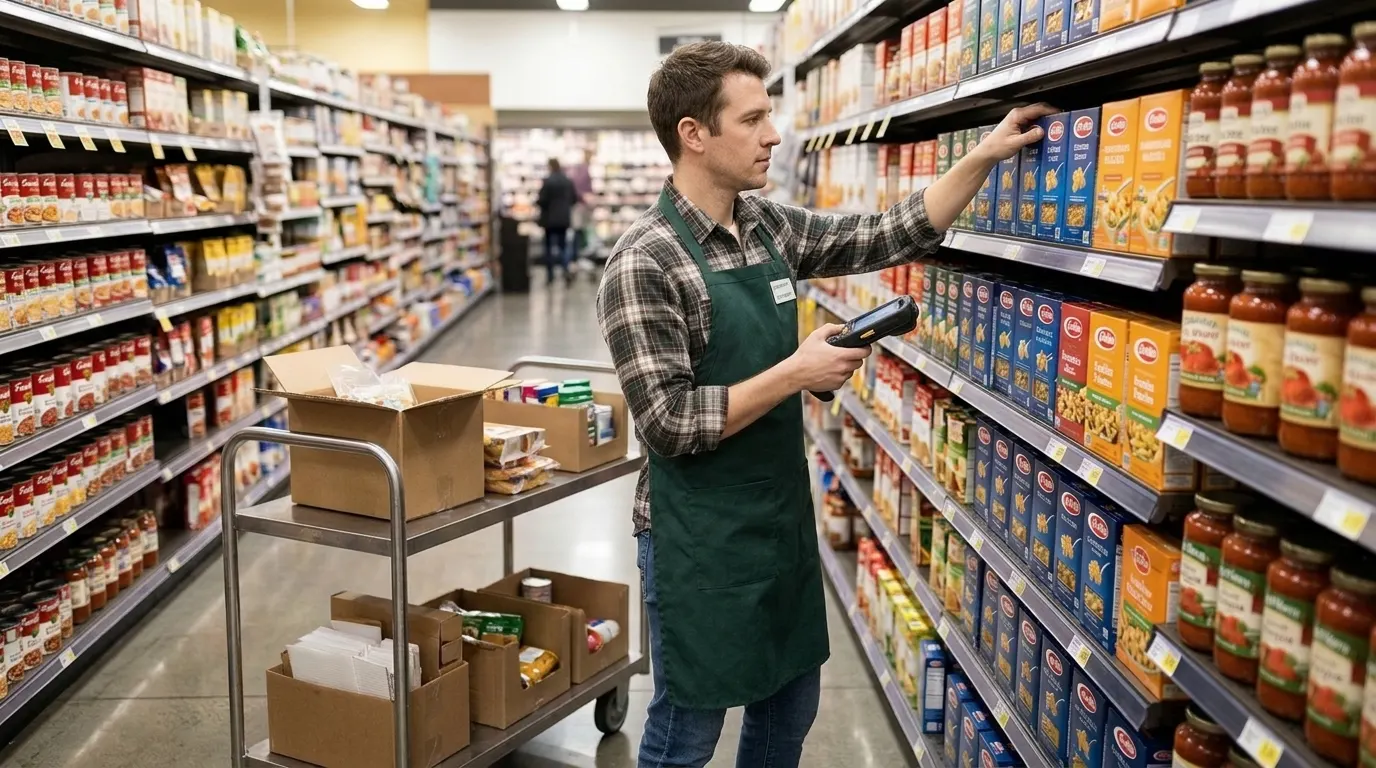
Managing grocery inventory is one of the most important responsibilities of a grocery store owner. A shop needs enough stock to meet customer demand, but purchasing more products than necessary can create problems. Items may remain unsold, lose quality, expire, or occupy valuable storage space.
These problems affect both small kiryana stores and supermarkets. A neighbourhood shop may struggle with slow-moving packaged products, while a supermarket may need to manage hundreds of fresh, chilled, frozen, and shelf-stable items.
Better grocery inventory management helps grocery businesses maintain product availability, control purchasing costs, identify products approaching expiry, and reduce avoidable food waste.
Pakistan also faces wider food loss and waste challenges. A 2021 assessment by the Institute of Business Administration’s Centre for Business and Economic Research estimated that around 18 million tonnes, or nearly 15% of food produced in Pakistan, was lost or wasted across the food supply chain. These figures are a national estimate, not a measurement of waste generated by grocery stores alone.
This article covers practical inventory management methods that grocery retailers in Pakistan can use to organise stock and reduce unnecessary waste.
What Is Grocery Inventory Management in a Grocery Store?
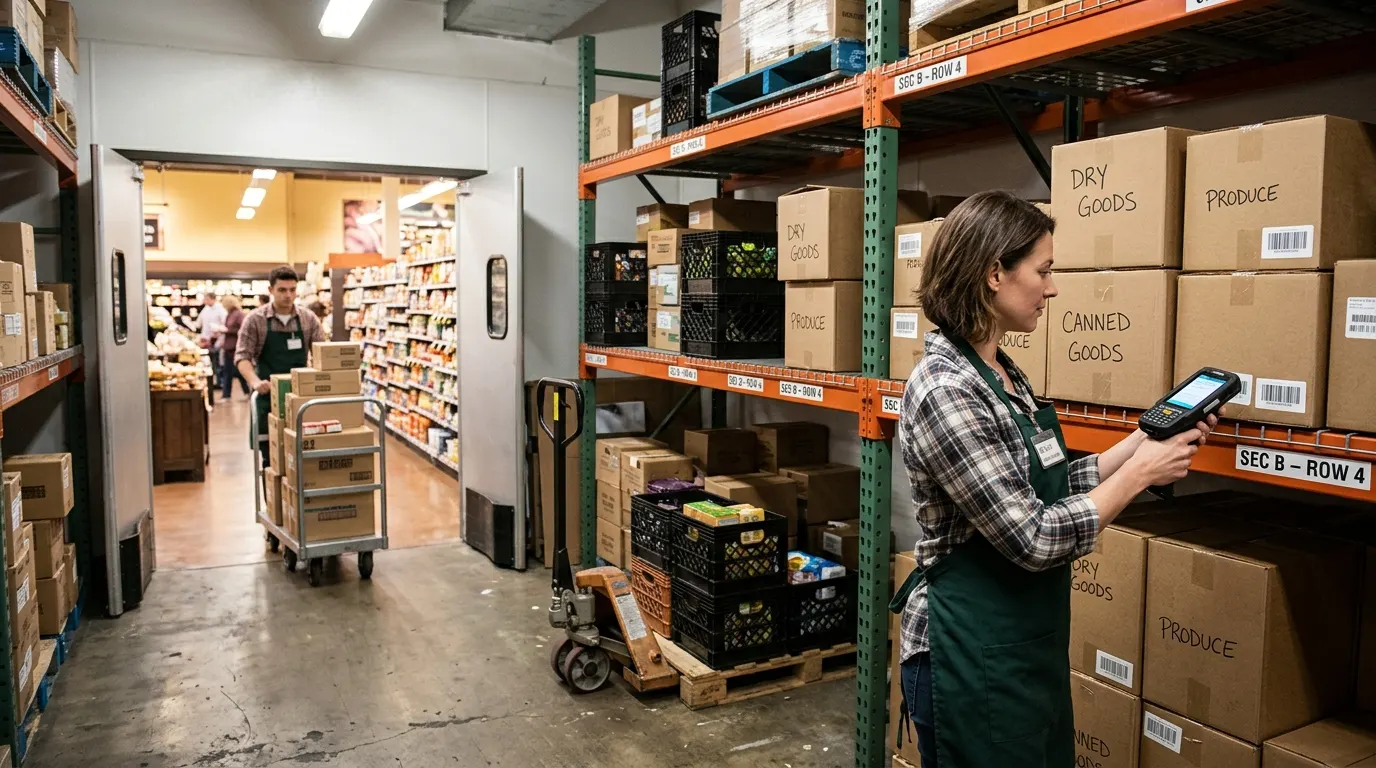
Inventory management is the process of recording, monitoring, purchasing, storing, and controlling the products a business keeps for sale.
For a grocery store, grocery inventory can include:
- Atta, rice, daal, sugar, and cooking oil
- Tea, spices, sauces, and packaged food
- Biscuits, snacks, noodles, and beverages
- Milk, yogurt, butter, and other dairy products
- Fresh fruits and vegetables
- Meat, chicken, fish, and frozen products
- Household cleaning and personal care items
A good grocery inventory system helps a retailer understand what is available, what is selling, what needs replenishment, and which products may become unsellable if they are not handled properly.
Small shops can begin with a notebook or spreadsheet. Larger supermarkets may require dedicated inventory software connected to purchasing, billing, and warehouse operations.
Why Inventory Management Matters for Grocery Businesses
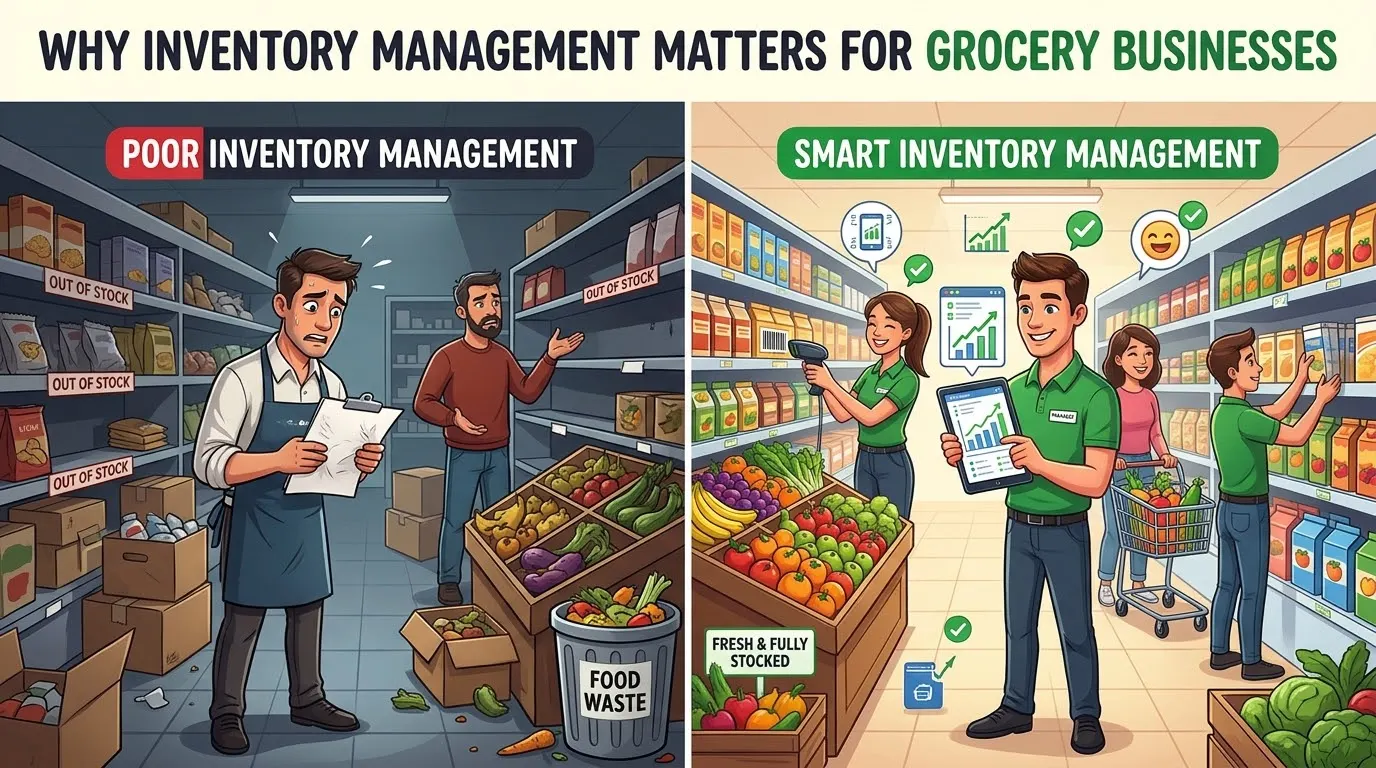
Poor stock management can create financial and operational problems. A store may have too much of one product while running out of another item that customers purchase regularly.
Here are some reasons why organised grocery inventory management matters.
1. Reduces Expired and Unsold Products
Grocery products have different shelf lives. Milk, yogurt, bread, fresh vegetables, and meat generally require more frequent monitoring than products such as rice, sugar, or packaged salt.
If a retailer does not monitor expiry dates and product movement, items may remain on shelves until they are no longer suitable for sale.
Regular stock checks help identify these products earlier and give the business more time to take appropriate action.
2. Prevents Overstocking
Buying large quantities does not always reduce costs. A product may have a lower purchase price when ordered in bulk, but the savings can disappear if part of the stock remains unsold or deteriorates.
Retailers should consider sales history, available storage space, product shelf life, and expected demand before placing large orders.
3. Reduces Stock Shortages
Customers may visit a grocery store for everyday products such as milk, eggs, atta, cooking oil, tea, and sugar.
If these products are frequently unavailable, customers may purchase them from another retailer.
Monitoring stock levels helps businesses identify when to reorder products before they run out.
4. Improves Cash Flow
Money spent on unnecessary stock is money that cannot be used for other business requirements.
Excess inventory may remain unsold for weeks or months, while the retailer still needs to pay suppliers, salaries, electricity bills, rent, and other operating expenses.
Purchasing according to actual demand can help businesses avoid tying up too much money in slow-moving products.
5. Improves Storage and Product Quality
Different grocery products require different storage conditions.
Dry goods need protection from moisture and pests, while chilled and frozen products require appropriate temperature control.
An organised stock system makes it easier to monitor product placement, storage conditions, and handling practices.
How Grocery Stores Can Manage Grocery Inventory Effectively
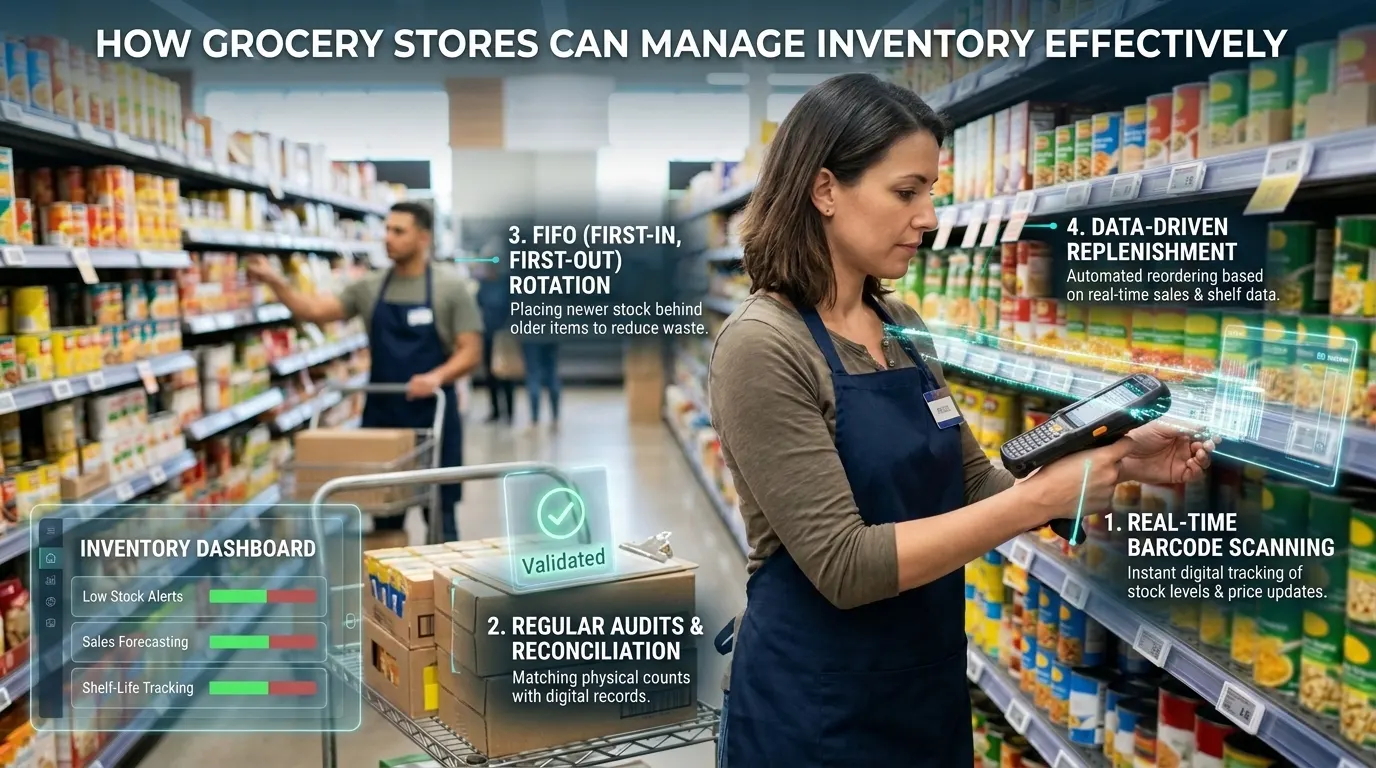
Grocery retailers do not necessarily need expensive software to improve stock control. They can begin with a few consistent procedures and introduce more advanced systems as their business grows.
1. Maintain a Complete Stock Register
Every grocery business should maintain a record of its products and stock movements.
A basic inventory register should include:
- Product name and brand
- Product size or pack quantity
- SKU or internal product code
- Opening stock
- Quantity purchased
- Quantity sold
- Damaged or wasted quantity
- Closing stock
- Supplier name
- Batch number and expiry date, where applicable
For example, a retailer selling a 1-litre cooking oil bottle should record it separately from a 5-litre container. Different pack sizes should not be combined into one stock record if their quantities and selling prices differ.
The register should be updated whenever stock is received, sold, returned, damaged, or removed from inventory.
A notebook may be sufficient for a small shop with a limited product range. A spreadsheet or inventory application can make the process easier when the number of products increases.
2. Use FIFO and FEFO Stock Rotation
Two useful stock rotation methods are FIFO and FEFO.
FIFO — First In, First Out
FIFO means the products received first should generally be sold first.
For example, if a grocery store receives two deliveries of packaged rice, the older suitable stock should be positioned so that it is sold before the newer delivery.
This method is useful for organising products that do not have a significant difference in expiry dates.
FEFO — First Expired, First Out
FEFO means the products with the earliest expiry dates should be sold first, regardless of when they arrived.
For example, a shop may receive a new delivery of yogurt with an expiry date of 20 December and still have an older delivery with an expiry date of 15 December. The earlier-expiring stock should be prioritised.
FEFO is particularly useful for dairy products, packaged foods with shorter shelf lives, and other date-sensitive grocery inventory.
Retailers should check product condition and safety before sale. Stock rotation does not make an expired or unsafe product suitable for customers.
The Punjab Food Authority’s food safety training guidance includes FIFO and FEFO implementation, storage, cold-chain management, and waste management among its training topics.
3. Identify Fast-Moving and Slow-Moving Products
Not every product sells at the same rate.
Fast-moving products may include frequently purchased essentials such as atta, milk, eggs, bread, tea, sugar, and cooking oil. The actual sales rate depends on the store’s location and customers.
Slow-moving products may include speciality ingredients, less popular flavours, seasonal items, or products with limited local demand.
Retailers should review sales records to identify which products move quickly and which remain on shelves for longer periods.
This information can help them:
- Maintain sufficient stock of frequently purchased items.
- Reduce unnecessary orders for slow-moving products.
- Review products that regularly remain unsold.
- Adjust shelf space according to customer demand.
- Avoid repeatedly purchasing items that generate avoidable waste.
A product should not be discontinued simply because it sells slowly for a short period. Retailers should also consider seasonality, customer preferences, profit margins, and supplier arrangements.
4. Set Minimum and Maximum Stock Levels
A grocery store should establish reasonable stock limits for regularly purchased products.
A minimum stock level identifies when an item needs replenishment. A maximum stock level helps prevent unnecessary purchasing.
For example, a shop may decide to maintain a minimum of 10 cooking oil bottles and a maximum of 40 bottles. When stock approaches the minimum level, the retailer can review sales and place a suitable order.
The exact limits should depend on:
- Average daily or weekly sales
- Supplier delivery time
- Product shelf life
- Storage capacity
- Seasonal demand
- Available working capital
Retailers can also calculate a basic reorder point:
Reorder Point = Average Daily Sales × Supplier Lead Time + Safety Stock
For example, if a shop sells 5 bottles of a product per day, the supplier takes 3 days to deliver, and the retailer keeps 5 additional bottles as safety stock:
(5 × 3) + 5 = 20 bottles.
The retailer may consider placing a new order when stock reaches approximately 20 bottles. This is an illustrative calculation; actual reorder levels should account for changing demand and supplier reliability.
5. Monitor Expiry Dates Regularly
Expiry monitoring should be part of daily store operations, especially for products with shorter shelf lives.
Retailers can organise expiry checks according to product type and sales volume.
For example:
- Dairy products and fresh food: Check frequently and follow required storage conditions.
- Bread and bakery products: Monitor dates and product condition regularly.
- Packaged snacks and sauces: Check during stock receiving and routine shelf inspections.
- Long-lasting pantry products: Include them in scheduled stock reviews.
When receiving a delivery, employees should check the product quantity, packaging condition, batch information, and relevant dates.
Products approaching their expiry dates should be identified early. Depending on the product, applicable food-safety requirements, and the remaining shelf life, a retailer may consider an approved discount, supplier return, or safe donation.
Expired, damaged, contaminated, or otherwise unsafe food must not be sold or donated for human consumption.
For more information about product information and dates, see Grocer.pk’s article on How to Read a Grocery Product Label.
6. Manage Fresh Fruits and Vegetables Carefully
Fresh fruits and vegetables can be a major source of waste when stores purchase more than customers are likely to buy.
Unlike many packaged groceries, fresh produce can deteriorate quickly because of temperature, humidity, handling, and storage conditions.
Retailers can improve fresh produce management by:
- Purchasing quantities according to expected daily or weekly sales.
- Checking quality when deliveries arrive.
- Removing damaged or deteriorating produce from sale.
- Separating products that require different storage conditions.
- Avoiding unnecessary handling and stacking pressure.
- Monitoring seasonal changes in customer demand.
- Cleaning storage and display areas regularly.
For example, a shop that sells a high quantity of tomatoes during weekends may need different purchasing quantities on weekdays.
The objective is to maintain fresh products for customers without keeping more stock than the store can reasonably sell.
7. Improve Storage for Dairy, Meat, and Frozen Products
Dairy products, meat, chicken, fish, and frozen foods require careful handling and suitable storage conditions.
A retailer should follow the storage instructions provided by manufacturers and applicable food-safety requirements.
Important practices include:
- Maintaining suitable refrigeration and freezer temperatures.
- Monitoring refrigerator and freezer performance.
- Avoiding unnecessary opening of cold-storage units.
- Checking product packaging for leaks or damage.
- Separating products where required to prevent cross-contamination.
- Recording relevant temperature checks.
- Removing products that have become unsafe or unsuitable.
If a refrigerator or freezer stops working, the retailer should assess affected products according to food-safety requirements rather than assuming that they remain safe.
The Punjab Food Authority provides food-safety resources and regulatory information for food businesses operating in Punjab.
8. Forecast Demand Before Purchasing Stock
Demand forecasting means estimating how much of a product customers are likely to purchase during a particular period.
A retailer can start with simple sales records instead of relying entirely on guesswork.
For example, a shop may notice that demand for certain grocery items increases during Ramadan, Eid, winter, school reopening periods, or local events.
Other factors that can affect demand include:
- Seasonal weather
- Changes in product prices
- Promotional offers
- Customer purchasing habits
- Local competition
- Supplier delivery schedules
- Special occasions and holidays
Retailers should review previous sales records before placing seasonal orders. They should also avoid assuming that a previous year’s demand will automatically repeat at the same level.
A small shop can maintain weekly sales records in a spreadsheet. A larger supermarket may use grocery inventory software to compare historical sales and estimate future purchasing requirements.
9. Coordinate Purchasing With Suppliers
Poor coordination with suppliers can lead to unnecessary stock, delayed deliveries, and product shortages.
Grocery retailers should maintain clear supplier records and understand delivery schedules, minimum order quantities, return policies, and payment terms.
Useful practices include:
- Ordering products according to current stock and expected demand.
- Checking deliveries against purchase orders.
- Reporting damaged or missing items promptly.
- Recording supplier prices and delivery dates.
- Discussing suitable return arrangements for damaged goods.
- Reviewing products that repeatedly arrive with short remaining shelf lives.
Retailers should not accept deliveries without checking quantity, packaging condition, and relevant product dates.
Accurate product and supplier records are also important for larger businesses. For more information, read Why Grocery Wholesalers Should Fix Product Data Before Investing in E-commerce and AI.
10. Review Near-Expiry and Surplus Stock
Identifying surplus stock early gives retailers more options than waiting until products become unsellable.
Depending on the product and applicable food-safety requirements, possible actions may include:
- Offering a clearly labelled discount on suitable products before their expiry date.
- Returning eligible products to suppliers under agreed terms.
- Adjusting future purchasing quantities.
- Donating suitable excess food through appropriate organisations.
- Recording products that are no longer fit for consumption for safe disposal.
Discounts should never be used to sell expired or unsafe products. Retailers must also ensure that any donation meets the applicable food hygiene, storage, and safety requirements.
In Punjab, the Punjab Food Authority’s Disposal of Excess Food Regulations guide the donation and disposal of excess food. The regulations cover food that remains fit for human consumption, appropriate storage conditions, and record-keeping requirements.
These are Punjab-specific regulations. Businesses operating in other provinces should check the relevant local food authority’s rules before arranging food donations or disposal.
11. Track Food Waste and Identify Its Causes
A grocery store cannot properly reduce waste if it does not know which products are being wasted and why.
Retailers should maintain a simple waste record.
Useful information includes:
- Product name
- Quantity discarded
- Purchase or stock cost
- Date of disposal
- Reason for waste
- Supplier or batch information, where relevant
- Action taken to prevent a repeat
Common causes of grocery waste include:
- Products purchased in excessive quantities
- Poor demand forecasting
- Incorrect storage conditions
- Damaged packaging
- Expired products
- Refrigeration or freezer failures
- Products that customers rarely purchase
- Delays in delivery or handling
For example, if a store repeatedly discards fresh coriander, the owner should review purchasing quantities and daily sales rather than continuing to order the same amount.
A monthly waste review can help identify repeated problems and show whether purchasing and storage changes are working.
A Simple Inventory Management System for Small Kiryana Stores
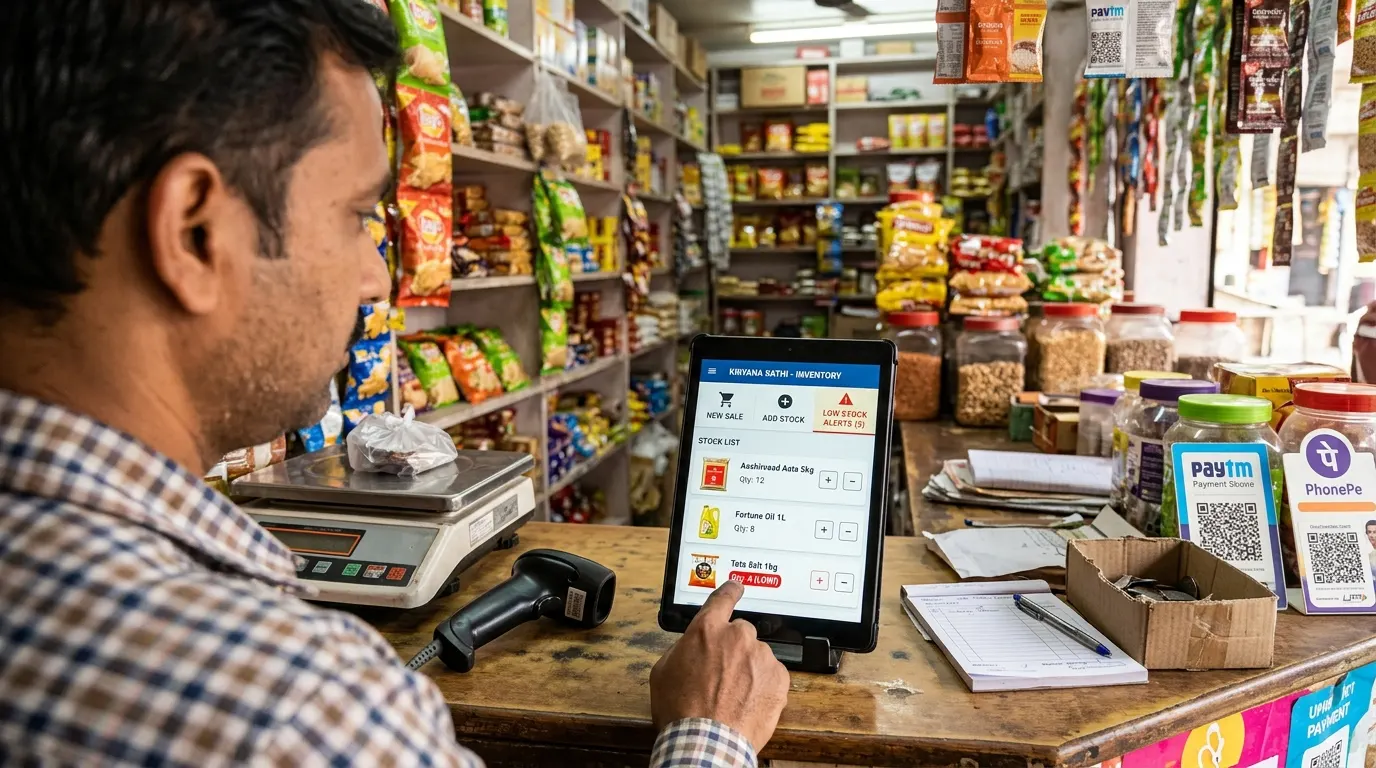
Small grocery stores may not need expensive grocery inventory software. A basic stock register and regular checks can provide a useful starting point.
A simple spreadsheet can include the following columns:
| Product | Opening Stock | Purchased | Sold | Damaged/Wasted | Closing Stock |
|---|---|---|---|---|---|
| Cooking Oil 1L | 30 | 20 | 35 | 1 | 14 |
| Sugar 1kg | 40 | 20 | 25 | 0 | 35 |
| Tea 190g | 25 | 10 | 18 | 0 | 17 |
| Milk 1L | 20 | 30 | 38 | 2 | 10 |
These figures are hypothetical examples. The closing stock calculation is:
Closing Stock = Opening Stock + Purchased − Sold − Damaged/Wasted
The register should be updated consistently, and the recorded quantity should be compared with the actual physical stock.
A small retailer can also use colour labels or separate shelves to identify products that need earlier attention. For products with expiry dates, the team should use FEFO rather than relying only on the order in which items arrived.
When Should a Grocery Store Use Inventory Software?
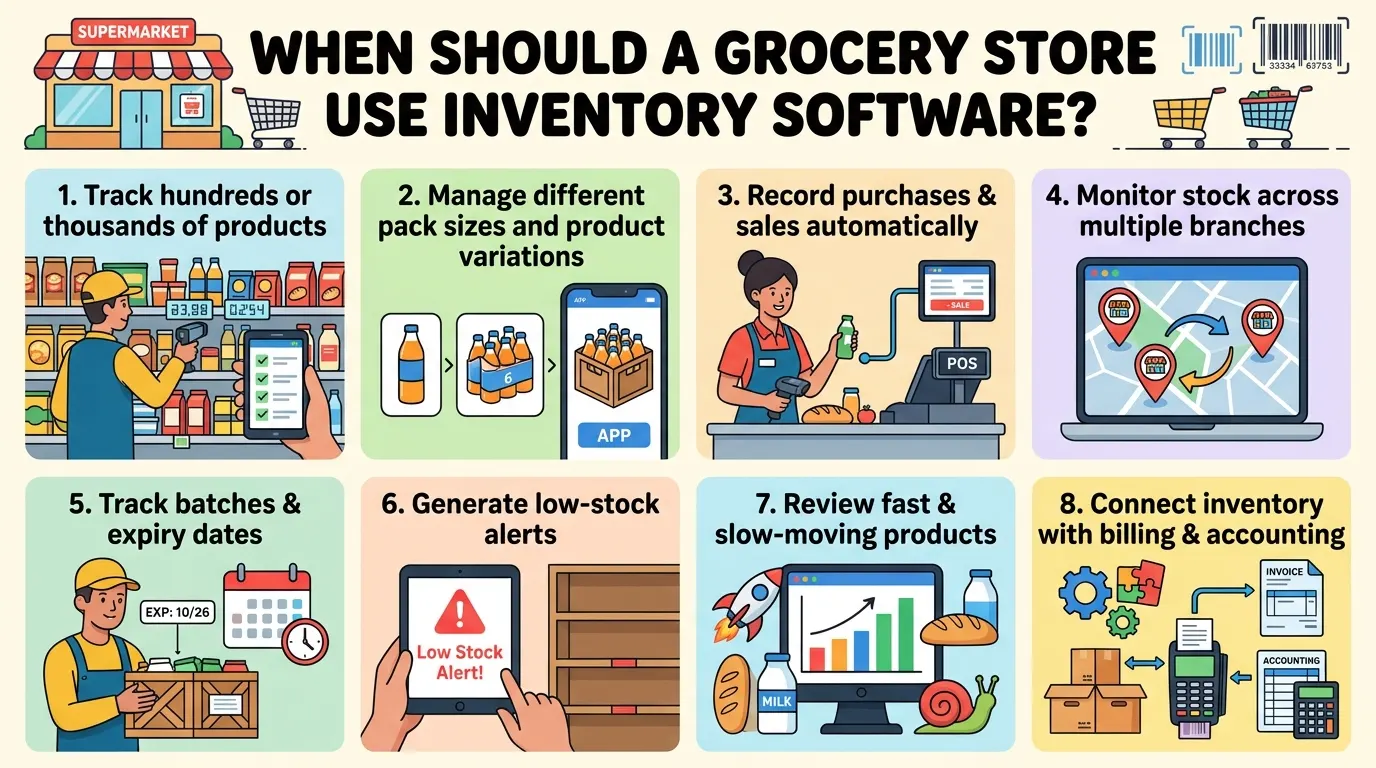
A notebook or spreadsheet may work for a small shop with a limited number of products. However, manual records become harder to maintain as the product range, number of employees, and daily transactions increase.
Inventory software may be useful when a business needs to:
- Track hundreds or thousands of products.
- Manage different pack sizes and product variations.
- Record purchases and sales automatically.
- Monitor stock across multiple branches.
- Track batches and expiry dates.
- Generate low-stock alerts.
- Review fast-moving and slow-moving products.
- Connect inventory with billing and accounting.
Before selecting software, a business should understand its actual requirements. A complicated system is not automatically better if employees cannot use it properly or product records are inaccurate.
Common Inventory Management Mistakes to Avoid
Grocery retailers can reduce avoidable losses by avoiding these common mistakes:
- Ordering without checking existing stock: This can lead to unnecessary purchases and overstocking.
- Ignoring expiry dates: Products may become unsellable before employees notice them.
- Mixing different pack sizes in one record: This creates incorrect stock quantities.
- Failing to record damaged products: The grocery inventory system may show more stock than the store actually has.
- Using only guesswork for purchasing: Sales records provide a better basis for estimating demand.
- Ignoring storage requirements: Poor storage can damage products even when their expiry dates have not passed.
- Failing to review slow-moving products: Repeated purchases of items with limited demand can increase waste.
- Not conducting physical stock checks: Differences between recorded and actual stock can remain unnoticed.
Frequently Asked Questions About Grocery Inventory Management
What is inventory management in a grocery store?
Inventory management is the process of recording, monitoring, purchasing, storing, and controlling grocery products. It helps retailers maintain sufficient stock, avoid unnecessary purchases, and reduce expired or damaged items.
What is FIFO in grocery inventory management?
FIFO stands for First In, First Out. It means products received earlier are generally sold before newer stock, provided they remain suitable for sale.
What is the difference between FIFO and FEFO?
FIFO prioritises the order in which products were received. FEFO prioritises products with the earliest expiry dates. FEFO is particularly useful for grocery items with different expiry dates.
How can small kiryana stores manage inventory?
Small kiryana stores can maintain a stock register, record daily purchases and sales, check physical stock regularly, monitor expiry dates, and use FIFO or FEFO where appropriate. A spreadsheet can also help organise records.
How can supermarkets reduce food waste?
Supermarkets can reduce food waste through better demand forecasting, appropriate purchasing quantities, stock rotation, expiry monitoring, suitable storage, staff training, and responsible management of surplus food.
Which grocery products need more frequent inventory checks?
Fresh fruits and vegetables, dairy products, meat, chicken, fish, bread, and other short-shelf-life products generally require more frequent monitoring than long-lasting packaged groceries.
Why is stock rotation important?
Stock rotation helps retailers sell suitable older or earlier-expiring products first. It reduces the likelihood of products being forgotten at the back of shelves or storage areas until they become unsellable.
Should small grocery stores use grocery inventory software?
Not necessarily. A notebook or spreadsheet may be sufficient for a small store. Grocery inventory software becomes more useful when the business handles a large product range, frequent transactions, multiple branches, or detailed batch and expiry tracking.
Final Thoughts
Inventory management is not simply about keeping shelves full. Grocery retailers need to understand what customers purchase, how quickly products sell, how much stock they should maintain, and which items require special storage or expiry monitoring.
Small kiryana stores can begin with a stock register, regular physical checks, and simple FIFO or FEFO procedures. Larger supermarkets can use inventory software, sales records, and demand forecasting to improve purchasing and stock control.
By monitoring stock movements, improving storage, coordinating with suppliers, and recording food waste, grocery businesses in Pakistan can reduce avoidable losses while maintaining better product availability for customers.
Syed Abdul Manan is an SEO expert and WordPress specialist with over 10 years of experience in search engine optimization and WordPress development. He holds a Bachelor of Science in Computer Science (BSCS) and is the Founder & CEO of Grocer.pk, a searchable directory of grocery stores, supermarkets, kiryana shops, and online grocery businesses across Pakistan.
With a technical foundation in computer science, he has spent the past decade working on technical SEO, on-page optimization, content strategy, and building fast, well-structured WordPress websites. For more than six years, he has been developing and managing Grocer.pk, which now covers major cities including Lahore, Karachi, Islamabad and Faisalabad, helping people find nearby stores by city, area and category, along with locations, contact details and map links.
Syed Abdul Manan runs Grocer.pk with a professional, quality-focused approach, combining clean site architecture, structured listings and practical grocery guides to serve both shoppers and business owners. His goal is to help local businesses build a stronger online presence and to help users find reliable local information quickly.
Connect with him on LinkedIn.